
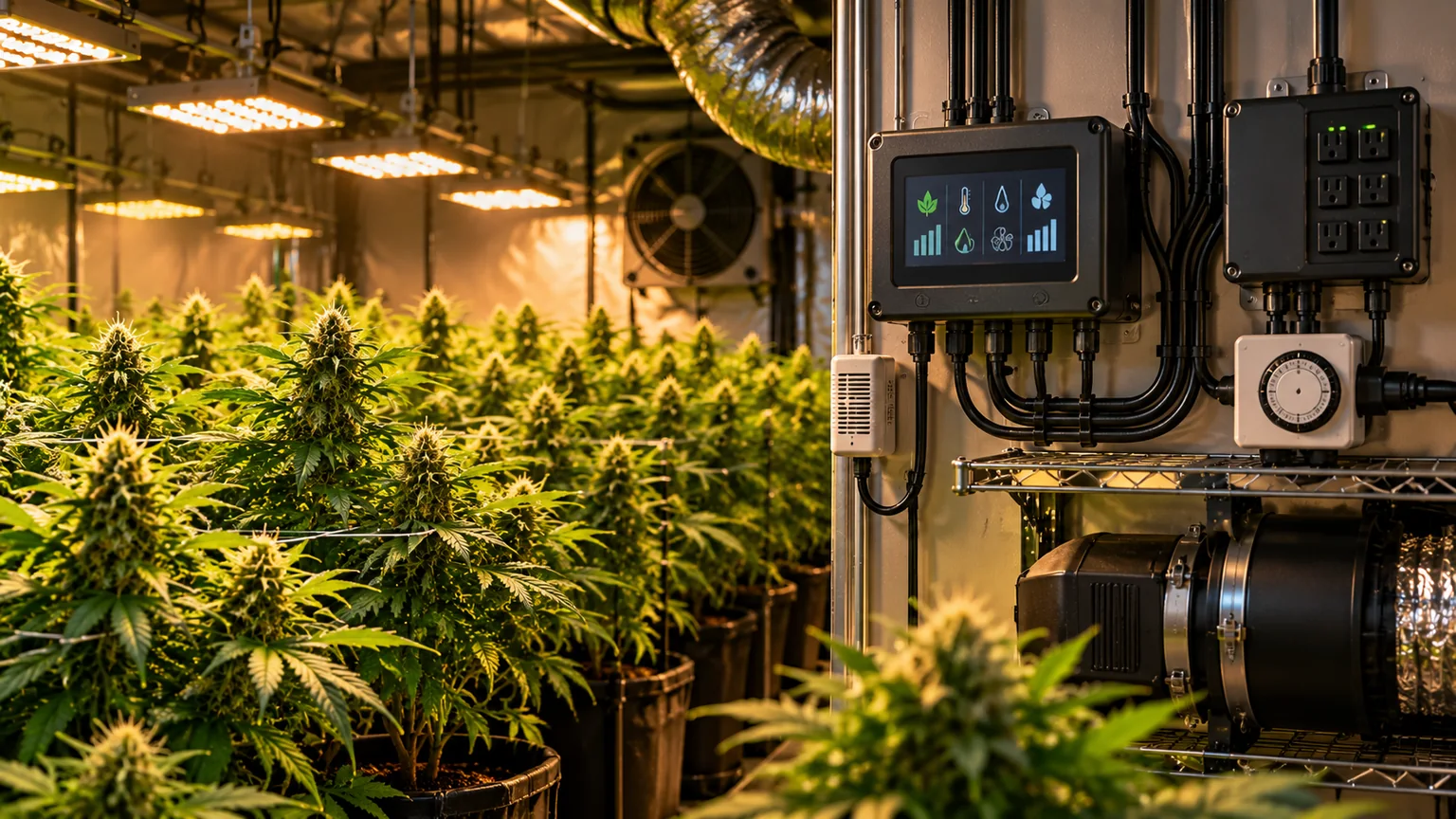
Schedules and sensors solve different problems. A timer switches equipment at chosen times. A thermostat or humidistat reacts to a measured condition. A monitor records conditions or issues an alert. Match the control method to the device—and plan what happens if it fails.
Choose the control that matches the job
Digital or mechanical timer
Turns lights or appropriate irrigation equipment on and off at specified times. It does not know whether plants are hot, a pump has lost prime, or the reservoir has overflowed.
Use for: repeatable schedulesThermostat or humidistat
Reads a sensor and calls for a fan, heater, dehumidifier, or other compatible device when conditions cross a configured threshold. Check the sensor location, response delay, and supported electrical load.
Use for: temperature and humidity responseEnvironmental monitor
Logs temperature, relative humidity, or other readings and may send alerts. An alarm is not proof that the connected device actually switched, and internet-dependent alerts can stop during an outage.
Use for: visibility and failure detectionHow an environmental control loop works
A controller is useful only when its reading corresponds to the space the plants occupy and its output is rated for the device being controlled. The diagram shows the logic, not a wiring plan.
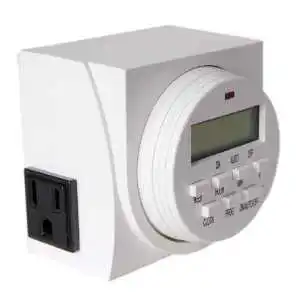
For a manual timer, verify the current time after a power outage and confirm that the device follows the programmed on/off cycle. For a sensor controller, test a safe simulated threshold and verify the equipment responds.
Five checks before connecting equipment
Compare the equipment nameplate to both the controller output and the circuit. Motor startup and ballast/driver inrush may exceed steady running current. Never assume that a plug physically fitting means the switch is rated for the load.
Route water and hoses away from controllers and receptacles, use appropriate protected outlets and enclosures, and arrange drip loops where appropriate. Consult a qualified electrician for wet-location circuit design.
Measure near the plant canopy, shielded from direct light, heating equipment, exhaust drafts, and splashing water. Compare readings with an independent reference occasionally.
Do not let heaters and exhaust cooling fight each other. Configure sensible delays and thresholds in compatible controllers; check the equipment manufacturer's instructions.
Know what turns off, stays on, or alerts you after a power interruption, sensor error, disconnected probe, or controller failure. Never depend on a single internet alert for a safety-critical function.
Test common failure cases
Unplug and restore a test timer without live critical loads; confirm clock, program, and output state behave as expected.
Move a reference sensor briefly into the same location and compare values. Replace defective or persistently inaccurate sensors.
Disconnect power safely. A welded relay or incompatible high-inrush load needs servicing or replacement, not repeated cycling.
Verify actual flow or airflow, not just an illuminated controller. Add a suitable independent alarm or regularly scheduled inspection.
Run one change at a time, record the configuration, and check actual equipment response. If any device repeatedly trips protection, overheats, or has damaged wiring, take it out of service and get it inspected.
Continue exploring
Further reading
University of Alaska Fairbanks Extension — Controlling the Greenhouse Environment discusses sensors, controller coordination, and placement. OSHA — Electrical: Flexible Cords describes hazards from damaged cords, strained connectors, and wet connections.