
EQUIPMENT SELECTION / LIGHTS, PUMPS AND CLIMATE
Choose a control for the job—not just the outlet.
Grow-room controls range from simple plug-in timers to equipment-rated environmental controllers. Before buying, match the actual device, electrical load and switching behavior to the controller's specifications. A timer does not measure temperature or confirm that a pump delivered water.
01 / BUYING COMPARISON
Compare the three common control categories.
| Control type | What it does | Verify before buying |
|---|---|---|
| Plug-in digital timer | Schedules a compatible light or other approved load at specific clock times. | Rated load, switching/inrush compatibility, minimum interval, clock backup and behavior after outage. |
| Cycle / repeat timer | Repeats ON and OFF intervals for compatible pumps and other equipment. | Minimum/maximum cycle time, pump motor rating, safe unattended operation and expected failure state. |
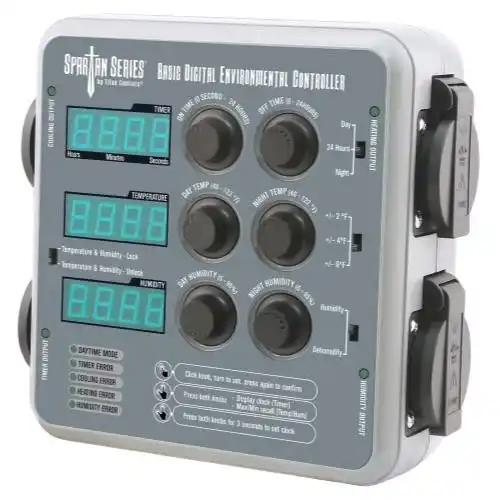
| Temperature / humidity controller | Responds when a connected sensor reaches a configured threshold. | Sensor range and placement, output ratings, hysteresis, protective limits and power-loss behavior. |
Multi-outlet control boxes can simplify a system, but outlet count is not proof of available circuit capacity. Compare the device nameplate, controller rating and circuit requirements together.
02 / READ THE LABEL
Five specs matter more than a long feature list.
- Actual electrical rating. Compare amps/watts, voltage and equipment type; motor start-up or LED-driver inrush can exceed steady draw.
- Program behavior. Check shortest interval, time-of-day versus repeat-cycle mode, and whether the clock survives a power outage.
- Appropriate switching. A standard light timer may not be designed for repeated motor starts or inductive loads.
- Physical environment. Consider dust, humidity, cable strain, water exposure and suitable mounting.
- Fault response. Know whether the controller restarts, stays off or returns to its prior setting after losing power.
03 / BEFORE YOU INSTALL
Map the devices you intend to automate.
Record the equipment name, running and start-up requirements, control method, interval or threshold, and expected state after failure. Then test one device at a time in a safe configuration.
For sensor placement, coordinating heating and ventilation, and controlled fault tests, use our Timers and Atmospheric Controls guide. For system planning and equipment sizing, see the Grow Room Builder and Hydroponic Water Pumps.