
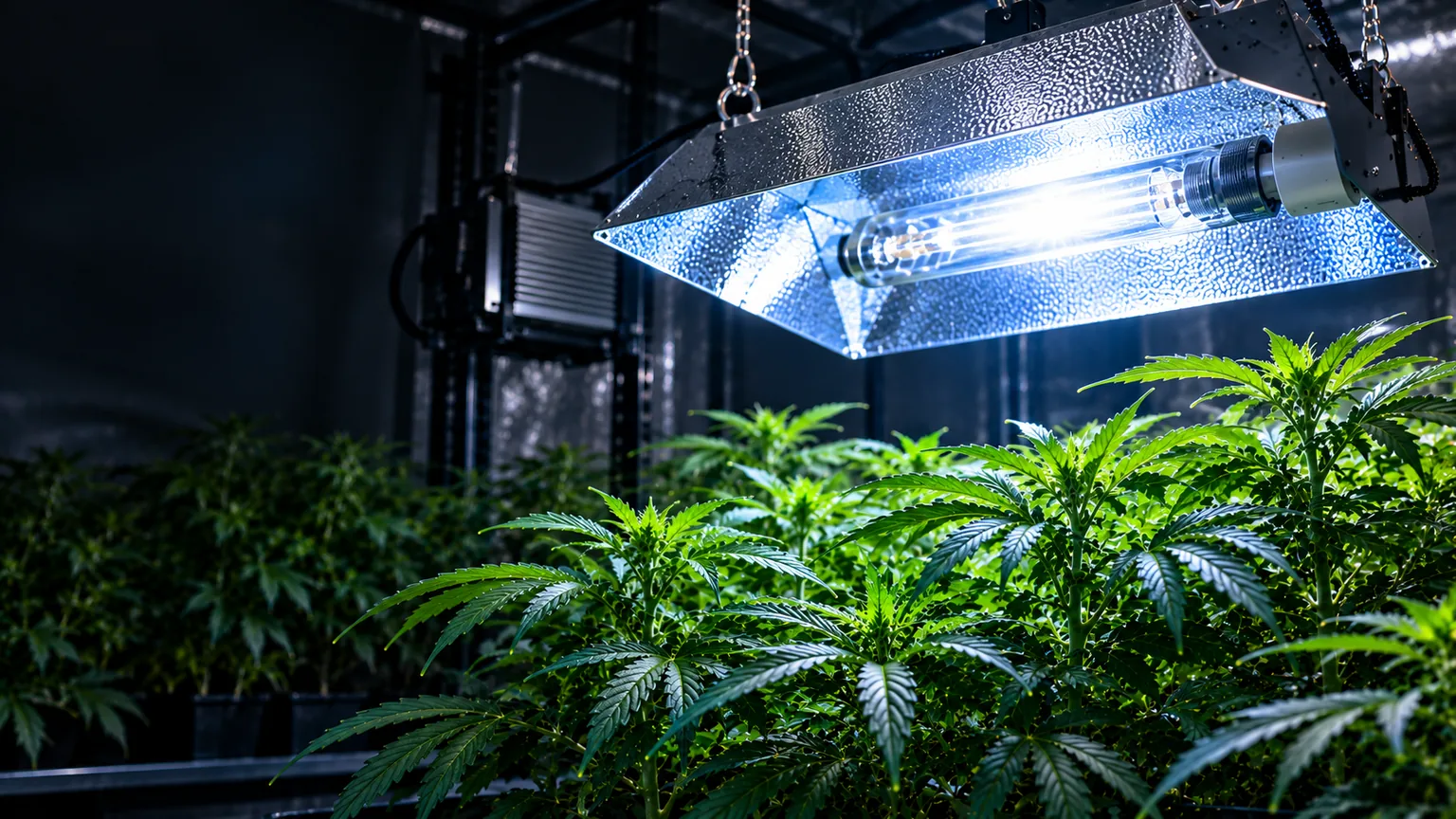
Metal halide still works. The entire lighting system matters.
Metal halide (MH) lamps helped define indoor vegetative growing. Their crisp, broad-spectrum output can support strong plant growth, but the bulb alone cannot tell you how much light a canopy actually receives. A sound setup starts with a matched ballast, protected lamp, stable suspension, ventilation, and measured coverage—not a promise attached to “blue” light or a wattage number.
Four parts of an MH grow-light system
An MH arc tube requires an appropriate ballast for starting and regulating current. Lamp, ballast, socket and enclosure ratings must agree. The reflector directs light toward the canopy, and clearance and ventilation control how heat affects the room. Use the fixture manufacturer's instructions—not visual similarity—to establish compatibility.
Ballast and socket
Match the exact lamp technology, rated wattage, socket, voltage and ballast type. A nonmatching HPS ballast or mislabeled “conversion” lamp is not an automatic substitute.
Reflector and containment
Use the required rated enclosure or protective glass, secure hangers and clearances. Some MH lamps are specified only for enclosed fixtures due to potential arc-tube failure.
Heat and ventilation
MH creates radiant heat and adds thermal load to the grow room. Check canopy temperatures, distance and exhaust capacity after the fixture has stabilized.
Rated electrical circuit
Account for ballast input draw, plugs, timers, surge/startup behavior and the total circuit load. Keep connections out of water and avoid improvised wiring.
Why a “400W MH” is not a canopy-coverage plan
Watts measure electrical input. They do not specify how many useful photons reach your plants. For that, use a trustworthy fixture PPFD map at the proposed mounting height or a quantum sensor. Compare the center with the edges, then adjust lamp height, plant layout and ventilation without violating the fixture's minimum clearance.
This illustrates the DLI calculation for a measured average PPFD, not a recommended number for every cultivar or growth stage. Strong center readings cannot compensate for underlit edges.
For practical fixture positioning and canopy mapping, use the Indoor Grow Lights guide and Grow Room Builder. The right distance varies with reflector geometry, lamp output, ventilation and plant response.
Metal halide, HPS and LED each solve different problems
Metal halide
Established HID equipment with a spectrum commonly used for vegetative growth. Practical when a safe, compatible system already exists, but it adds heat and recurring lamp maintenance.
HPS
Another HID approach historically used for flowering. It needs compatible ballast and socket hardware, produces significant heat and is not automatically the better choice for larger harvests.
Modern horticultural LED
Often higher electrical efficacy with adjustable, distributed fixture layouts. Compare actual PPF/PPE, coverage maps, serviceability and price instead of relying on “equivalent wattage.”
The old claim that MH's blue output is uniquely required for vigorous cannabis growth is too broad. Spectrum influences plant responses, but intensity, daily light exposure, leaf temperature, cultivar and other growing conditions matter too. A quality LED can support vegetative growth without an MH lamp.
Heat, lamp condition and disposal checklist
- Verify the complete fixture. Check ballast, lamp, socket and enclosure ratings, protective glass and hanging hardware before energizing the system.
- Allow cooling before servicing. Turn off power, let hot components cool and follow manufacturer procedures. Never handle a damaged or exposed discharge lamp while energized.
- Measure light and temperature. Look for canopy hot spots and weak edges, and account for the heat introduced into the room.
- Inspect the lamp rather than trusting a universal calendar. Follow manufacturer's rated service life, track hours and replace damaged, unstable or visibly deteriorating lamps according to specifications.
- Recycle spent bulbs correctly. Metal halide lamps are mercury-containing HID lamps; use approved local recycling or hazardous-waste handling rather than regular trash where applicable.
A nominal 400W lamp run 18 hours per day represents at least 7.2 kWh/day from its lamp wattage alone. Actual meter consumption includes ballast losses and cooling loads. Use the grow-light electricity cost calculator with real fixture input watts and your utility rate.
The 250W and 400W Hortilux Blue setup

A grower's observation—not a universal formula
The original account describes using a 250W Hortilux Blue metal halide fixture for recently rooted clones, then a 400W Hortilux Blue fixture as plants developed into mother plants. The grower found the 400W arrangement easier to manage than a previous 1,000W setup because the larger system added too much heat.
The source also describes a 24-hour vegetative photoperiod and roughly annual bulb changes. Those were practices in that room, not requirements for healthy plants or all lamps. Mother plant maintenance depends on plant health, conditions and repeatable cutting production—not a single mandatory fixture or schedule.
References and further reading
University of Missouri Extension — Understanding Grow Lights explains PPFD, DLI and fixture positioning. US EPA — Recycling and Disposal of Mercury-Containing Lamps includes metal halide HID lamps. Check the specific fixture and lamp manufacturer's safety instructions for use and containment.