

PLANT HEALTH / NUTRITION BASICS
Cannabis needs a balanced supply of essential mineral nutrients, not the largest collection of bottled additives. What works depends on the growing medium, water quality, available nutrients and the plant's condition. A fertilizer label is a starting point—not proof that a particular brand will deliver larger flowers.
What nutrients do cannabis plants actually need?
Like other vascular plants, cannabis uses nitrogen, phosphorus and potassium in substantial amounts. It also needs calcium, magnesium, sulfur and much smaller quantities of iron, manganese, zinc, copper, boron, molybdenum, chlorine and nickel. Carbon, hydrogen and oxygen come primarily from air and water. A complete feeding program has to account for the nutrients already present in the medium and water.
Nitrogen
Supports leaf growth, proteins and chlorophyll. Too little or too much can impair development.
Phosphorus
Supports energy transfer and development. More phosphorus is not automatically better for flowers.
Potassium
Helps regulate water balance and many enzyme processes. Adequate supply matters throughout growth.
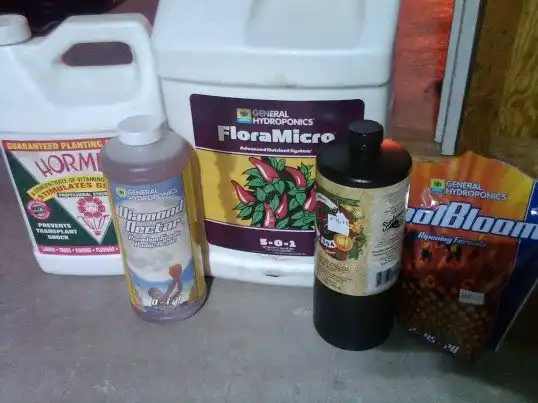
On most fertilizer packages, the three N-P-K numbers give the percentage by weight of total nitrogen, available phosphate expressed as P₂O₅, and soluble potash expressed as K₂O. A 4-2-3 label does not mean the product can be used at any concentration. See the NPK ratio guide for a closer look at different nutrient formulations.
Soil, coco and hydroponics: different starting points
Soil and amended mixes
Organic matter and mineral reserves can contribute nutrients. Testing helps establish what is present before adding more. Media aeration, watering and microbial activity affect availability.
Coco and soilless substrates
These systems often rely more directly on supplied fertilizer. Water chemistry, drainage and nutrient balance remain important; follow the chosen system's instructions and observe the plant.
Water culture / hydroponics
Roots depend on a properly balanced solution, dissolved oxygen, suitable pH and sanitary equipment. Monitor solution concentration and replace or adjust it based on reliable measurements rather than a fixed calendar alone.
The number of bottles in a nutrient line is not a meaningful quality score. A correctly formulated base feed can already provide the necessary elements. Supplemental products should have a clear purpose, compatible chemistry and evidence behind their claims. For additional plant-care fundamentals, browse the growing guides.
Diagnose before adding anything
Yellow leaves, marginal burn and slow growth can result from several causes besides nutrient deficiency: inappropriate moisture, root damage, excess salts, pH-related uptake problems, pests, temperature or light stress. An image alone rarely proves which element is missing. Work through the basics first.
- Check recent watering, drainage, root-zone condition and environmental changes.
- Measure pH with a calibrated instrument suited to the medium; compare with established guidance for that system.
- Review the fertilizer label, mixing instructions, water chemistry and any recent additions.
- In recirculating hydroponics, use electrical conductivity as one indicator of total dissolved fertilizer salts—not as a measurement of each individual nutrient.
- When possible, use substrate, soil, solution or tissue testing to confirm a suspected imbalance before making large corrections.
Adding extra phosphorus or a branded bloom booster to a stressed plant can make an imbalance worse. Likewise, routine aggressive flushing has tradeoffs and is not a universal fix. Read the flushing guide alongside measurements and the selected medium's feeding requirements.
Common nutrient questions
- Are organic nutrients always better?
- No single label makes a fertilizer universally superior. Nutrient availability, growing method, consistency, environmental footprint and measured crop results are more useful comparisons.
- Should the feeding formula change during flowering?
- Nutrient demand can change with development, but plant condition and the actual formulation matter more than a simplistic rule to eliminate nitrogen or maximize phosphorus.
- What does EC tell you?
- Electrical conductivity reflects how well dissolved salts carry electricity. It can reveal broad changes in solution strength but cannot identify which individual elements are high or low.
- Do additives guarantee larger buds?
- No. Yield and flower quality depend on genetics, light, environment, root health and adequate balanced nutrition. Marketing claims are not a substitute for comparative evidence.
Plant nutrition references: University of Minnesota Extension: Small-scale hydroponics and interpreting soil tests.