
WATER CHEMISTRY / THE FIELD GUIDE
Read the unit.
Then read the number.
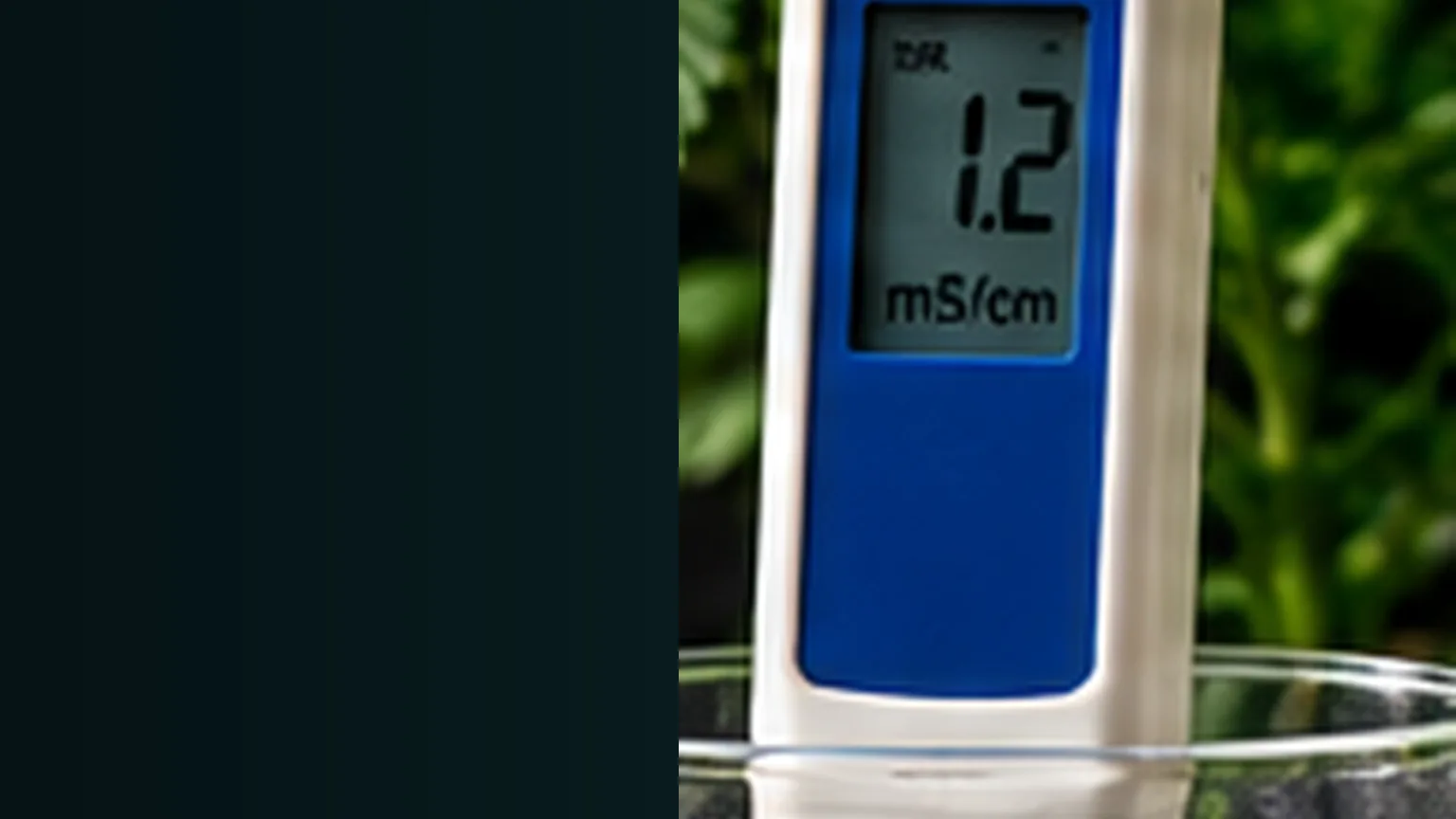
Dissolved charged particles make water conduct electricity. A nutrient solution usually becomes more conductive as dissolved mineral salts increase, but EC does not tell you which ions are present, whether a particular element is deficient, or how to mix a precise recipe from scratch.
01 / THE METER-READING LAB
One reading.
Four ways to display it.
Enter the number and unit shown on your meter. Convert a reading or compare two measurements on the same EC scale.
CONDUCTIVITY / NORMALIZED DISPLAY
Your reading, in four displays.
Enter a reading to see its equivalent displays.
PPM displays are conductivity-derived estimates. Converting a value does not improve your meter’s resolution or identify individual nutrients.
The reference chart below is available without the tool.
Scale formulas: Bluelab’s conductivity-scale explanation. Unit prefixes: NIST SI prefixes.
02 / THE REFERENCE CHART
EC and “PPM” are not interchangeable numbers.
Many handheld TDS meters turn conductivity into an approximate “ppm” value. Common 500 and 700 scales produce different numbers from the same solution. These are conversion conventions, not laboratory measurements of individual plant nutrients.
| EC (mS/cm) | µS/cm | PPM 500 scale | PPM 700 scale |
|---|---|---|---|
| 0.5 | 500 | 250 | 350 |
| 1.0 | 1,000 | 500 | 700 |
| 1.5 | 1,500 | 750 | 1,050 |
| 2.0 | 2,000 | 1,000 | 1,400 |
For example, a reading of 1.5 mS/cm becomes approximately 750 on the 500 scale or 1,050 on the 700 scale. Use EC units in shared records when possible.
An EC meter is an indicator of total soluble ions. It cannot distinguish added fertilizer from salts already present in the source water.
03 / BEFORE YOU ADJUST
Four readings that make the number useful.
Source water
Measure water before adding fertilizer. Background minerals, softened water and sodium all contribute to EC.
Calibrated meter
Confirm meter units, temperature compensation and calibration fluid; follow the manufacturer's specific reference value.
Finished solution
Mix complete fertilizer components as labeled, let the reading stabilize, then check both EC and pH.
Change over time
Compare reservoir volume, top-ups, uptake and temperature. Rising EC may indicate water loss; falling EC may indicate nutrient uptake or dilution.
04 / INTERPRETATION
There is no universal EC target for every cannabis plant.
Appropriate solution strength depends on cultivar, plant age, system, root health, source water, lighting and climate. Seedlings often tolerate less concentrated feed than established plants, but copying an unverified stage-by-stage EC chart risks overfeeding. Follow a complete fertilizer's product-specific instructions and compare trends with plant response.
Check root oxygen, moisture, temperature and water balance. High EC can create osmotic stress, but the symptom alone proves nothing.
Review the full nutrient program, starting water and root function. Simply raising every nutrient may not solve a specific limitation.
EC cannot tell you the nutrient ratios. Review NPK and the full guaranteed analysis and investigate other stresses.
05 / QUESTIONS AT THE METER
Before comparing the numbers.
Why can two meters show different PPM numbers?
They may use different conversion scales. The same EC reading produces different numbers on the 500 and 700 scales. Confirm the setting before comparing displays.
What if I do not know my meter’s PPM scale?
Check the model’s manual or settings. A PPM number alone is insufficient to choose a conversion factor. Use a direct EC reading when the meter provides one.
Does a higher converted value mean I need less fertilizer?
No. Unit conversion changes the display, not the solution. Even a measured change needs context: source water, temperature, sampling method, water level and recent additions.
Can this calculate individual nutrient concentrations?
No. Conductivity combines the effects of dissolved ions. Use an appropriate laboratory analysis when individual nutrient amounts or water composition matter.
Further reading
Missouri Extension: Hydroponic Nutrient Solutions · Oklahoma State: EC and pH · Purdue: Measuring soilless media
CONTINUE LEARNING