PLANT NUTRITION / A PRACTICAL DECISION GUIDE
There is no single best NPK ratio for every cannabis plant.
The useful question is whether your plants receive a complete, appropriately concentrated nutrient supply for their growth stage, growing medium and water. A fertilizer label is the starting point—not a universal feeding prescription.
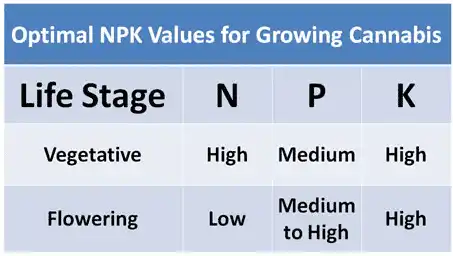
Quick answer: During vegetative growth, nitrogen supports rapid leaf and stem production. During flowering, plants still need nitrogen alongside adequate phosphorus and potassium. There is no credible rule that simply increasing P or K produces larger buds.
01 / GROWTH STAGE
What changes from seedlings to flowering?
Seedlings
Young roots are sensitive to excessive soluble salts. A prepared potting mix may already supply starter fertility; a hydroponic system needs a suitable complete solution. Judge the medium and the label before adding more.
Understand the seedling stage →Vegetative stage
Formation of leaves, stems and roots requires adequate nitrogen plus phosphorus, potassium and other essential nutrients. Choose a complete program designed for your medium rather than comparing the first NPK number alone.
Explore vegetative growth →Flowering stage
Nutrient demand shifts, but nitrogen does not become unnecessary. A product labeled “bloom” is not automatically superior, and very high phosphorus or potassium does not guarantee heavier flowers.
Understand flowering →Soil, coco and water culture can behave differently even with the same bottle. Genetics, starting nutrient reserves, application rate and environmental conditions matter more than a marketing name. For more on reproductive development, browse flowering guides.
02 / THE BOTTLE
NPK is a fertilizer grade—not a dosing schedule.
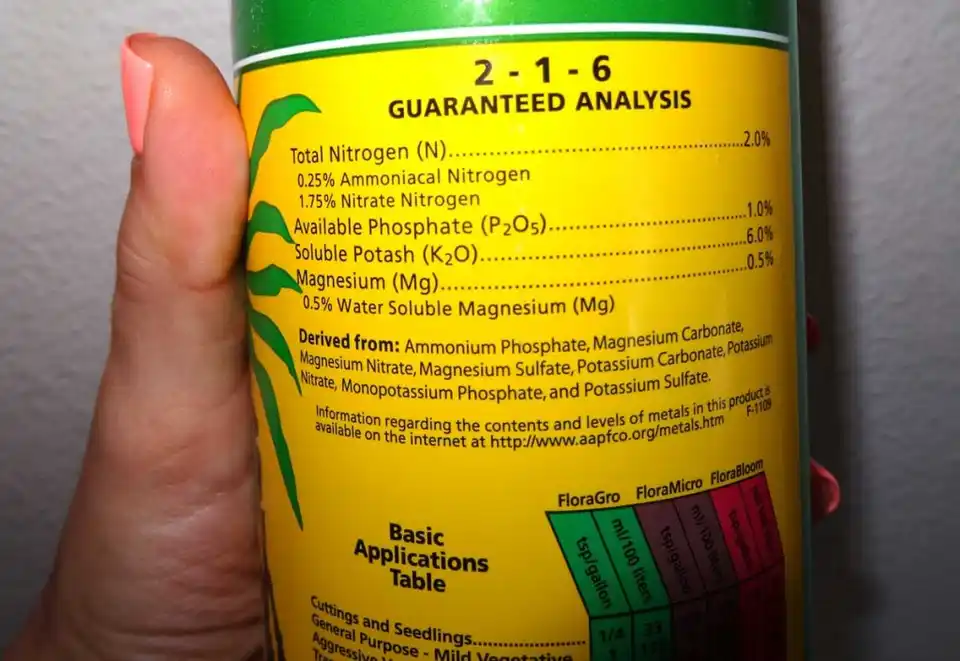
On U.S. fertilizer labels, the three guaranteed-analysis numbers normally express percentages by weight of total nitrogen (N), available phosphate (P₂O₅) and soluble potash (K₂O). The latter two are conventional oxide equivalents, not percentages of elemental phosphorus and potassium.
Two products can share the same NPK proportions but differ in strength, ingredients and directions. Follow the full guaranteed analysis and labeled application rates.
For detailed label conversions and the difference between fertilizer grades and actual nutrient concentration, read NPK Ratios Explained.
Look beyond the three bold numbers
Check the forms of nitrogen, calcium, magnesium, sulfur and other supplied nutrients, plus whether the instructions account for the growing medium. A full program matters more than an isolated NPK ratio.
03 / BEFORE YOU CHANGE A FORMULA
Four checks are more useful than chasing a magic ratio.
Know your medium
Find out whether your potting mix already contains nutrients. Controlled-release products are not universally unsuitable, but release rates and compatibility vary.
Read the complete program
Follow product-specific mixing directions and account for water quality. Do not improvise with a succulent fertilizer just because its grade appears similar.
Measure before adding
pH influences nutrient availability; electrical conductivity indicates soluble-ion concentration. Neither number independently diagnoses a deficiency.
Investigate symptoms
Leaf discoloration can have several causes, including root stress, moisture, pests and nutrition. Increasing fertilizer can make some problems worse.
Related references: root-zone pH, EC measurement, organic vs mineral nutrients and leaf symptoms.
04 / THE RESEARCH
More phosphorus or potassium does not automatically mean bigger flowers.
A controlled study of one high-THC cultivar in deep-water culture found flowering yield responded to nitrogen and phosphorus concentration, but not to potassium across the concentrations tested. Separate research on vegetative plants reported interactions among N, P and K. Neither study sets a universally optimal retail bottle grade across cultivars, soils and growing systems.
A different container study of a high-CBD cultivar found that extra phosphorus and potassium during reproduction did not increase inflorescence biomass or CBD content. Together these findings argue for balanced nutrition and evidence-based adjustments rather than a universal “bloom booster” rule.