

A PK booster adds phosphorus and potassium to a fertilizer program. Those elements are essential for healthy cannabis growth, but adding more than the plant can use does not reliably produce larger or more potent flowers. First find out what your base feed, water and growing medium already supply.
Phosphorus and potassium. Packaging often expresses them as P₂O₅ and K₂O percentages.
An optional addition when a balanced program does not cover a demonstrated need.
Extra phosphate does not automatically increase bud mass, cannabinoids or flavor.
What does PK booster mean?
In fertilizer terminology, P means phosphorus and K means potassium. Both are essential plant macronutrients: phosphorus participates in cellular energy transfer and plant development; potassium supports water regulation and many enzyme functions. A product described as a PK booster usually emphasizes these nutrients rather than supplying a complete, balanced fertilizer on its own.
The N–P–K numbers printed on many fertilizer labels give percentages by weight for total nitrogen, available phosphate as P₂O₅ and soluble potash as K₂O. They do not directly reveal how many milligrams per liter of elemental P or K will reach roots in a particular tank. Compare labels, mixing rates and the entire nutrient program rather than choosing a bottle because one number looks larger. For broader fundamentals, see the cannabis nutrient guide and NPK ratios explained.
Do PK boosters actually make bigger buds?
There is no reliable universal increase from adding a booster to an already adequate feeding program. In one controlled study of high-CBD cannabis, increasing phosphorus in the supplied solution from 25 to 75 mg/L did not significantly change flower yield or measured cannabinoid concentrations; it did increase phosphorus in the drainage water. A later controlled hydroponic study tested 15 to 90 mg/L phosphorus and two solution-strength levels, again finding no significant benefit to yield or quality from the higher inputs.
More input, not more yield
Higher phosphorus increased nutrient runoff, without a statistically significant yield or cannabinoid benefit in that tested high-CBD cultivar.
Read the study ↗More fertilizer, similar flowers
In the tested closed hydroponic setup, increased root-zone phosphorus and solution strength did not significantly improve yield or measured flower quality.
Read the study ↗These results are not a universal recipe for every cultivar, medium or growth condition. Correcting a real nutrient shortage matters. What the findings challenge is the claim that raising PK by itself reliably creates heavier, tastier or more potent cannabis.

When should you consider an additional PK product?
Start with an identifiable problem or a measured gap—not with the flowering-week number on a bottle. The right decision can differ between an amended soil mix, coco and recirculating hydroponics. There is no single safe PK dose or universal calendar for all cannabis plants.
Read the base nutrient label
Check the actual formulation and the manufacturer's complete feed schedule. A bloom formula may already provide sufficient P and K.
Inspect water and roots
Review drainage, watering and root-zone pH. In liquid systems, EC helps flag changes in overall dissolved salts, not the level of an individual element.
Verify the reason
Compare symptoms across the plant and, when feasible, use substrate, irrigation-water, solution or tissue tests instead of diagnosing from one leaf.
Make one documented change
Only supplement a justified need, follow the current product directions and monitor the response. Stacking concentrates can create unwanted nutrient imbalances.
Can PK boosters trigger cannabis to flower earlier?
No reliable evidence shows that a PK booster substitutes for the signals that initiate flowering. Photoperiod-sensitive cannabis responds primarily to appropriate light and dark cycles, together with genetic and physiological development. Phosphorus and potassium support plant function, but a fertilizer additive should not be treated as a flowering switch.
How do you recognize too much fertilizer?
High soluble-salt levels, deteriorating roots, poor drainage and mismatched nutrients can all contribute to stress. Burned leaf tips, marginal discoloration and stunted growth have many possible causes; no photograph or single EC reading identifies the offending nutrient. If foliage changes, work through leaf symptom diagnosis before reaching for another bottle. Routine flushing is not a universal solution either.
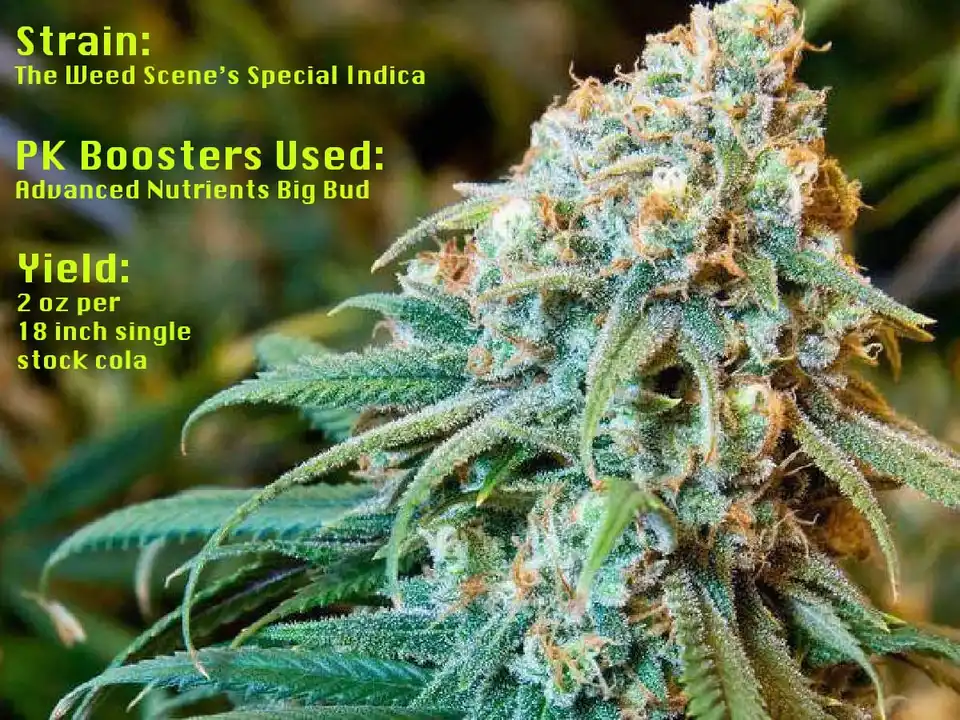
Big Bud in use
The Weed Scene's earlier grow notes identify Advanced Nutrients Big Bud as a product used with this indica plant. That is a firsthand product-use observation—not a controlled comparison or proof that the supplement caused larger flowers.