
Cannabis growing / Flower development
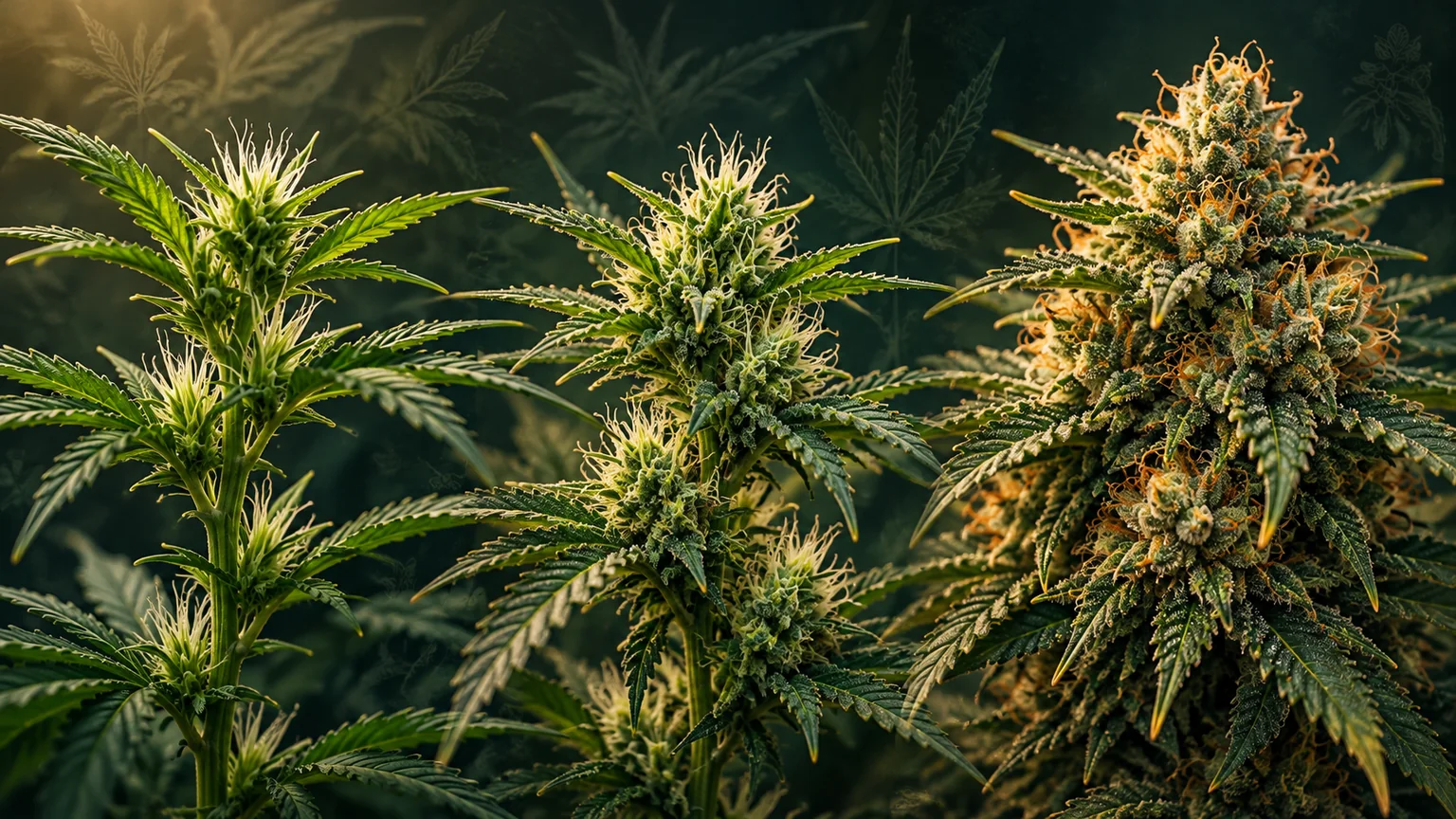
Flowers do not appear fully formed. First come reproductive structures and fine stigmas, followed by expanding clusters of bracts, resin-bearing trichomes and a changing canopy. Learning to recognize those features is more useful than memorizing a universal harvest date.
Cannabis buds are clusters of small flowers that form during the plant's reproductive (flowering) stage. On female plants, small flowers develop along stems and at branch tips, forming clusters often called buds or colas. These structures change in size, appearance and resin production as the plant matures. Photoperiod-sensitive varieties respond to day length, while autoflowering varieties can initiate flowering without the same seasonal signal.
01 / The flowering process
From first flowers to developing cannabis buds
A cannabis plant's flowering period is a progression of biological changes, not a single event. What you notice first depends on genetics, sex, environment and where you look on the plant. Mature flowers may be dense or open, and their appearance is not a reliable substitute for laboratory analysis of cannabinoids or contaminants.
Flower initiation
Reproductive growth becomes visible at nodes and growing tips. On female flowers, pale stigmas may extend from small bracts. New branching or stretching can continue during the transition.
Clusters form
More floral structures accumulate along the plant's branches. Small leaves appear within flower clusters, and glandular trichomes become more noticeable on surrounding tissue.
Flowers mature
Bracts and flower clusters continue changing in size and appearance. Stigmas can darken or curl; trichome appearance also changes. Neither observation alone establishes an exact harvest date.

Why cannabis buds can look different: cultivar genetics, branching structure, pollination history and growing conditions all influence floral appearance. Dense buds are not automatically more potent or safer than airy ones. Read the flowering plants overview for more context.
02 / What you're looking at
Cannabis bud anatomy, without the jargon
A bud is not one large flower. What growers commonly call a cannabis bud is an inflorescence: a grouping of many small floral parts. These are the terms worth recognizing when you look closely at a flowering plant.
- Cola
- A cluster of cannabis flowers, often developing near a branch tip. The main stem's upper cluster is sometimes called the main cola.
- Bract
- A modified leaf-like structure associated with a flower. Bracts become prominent within mature flower clusters.
- Stigma
- The pollen-receptive part visible as fine hairs, usually light-colored at first. These are often called “pistils” in grower conversations, although the terms are not identical.
- Trichome
- A tiny hair-like plant structure. Some glandular trichomes produce and store compounds including cannabinoids and terpenes.
- Sugar leaf
- A smaller leaf that grows among flowers, sometimes with visible glandular trichomes on its surface.
- Fan leaf
- A larger photosynthetic leaf. It has a different role and appearance from the flower's bracts and fine sugar leaves.
For labeled reference photographs and botanical definitions, see the University of Nevada, Reno Extension guide to female hemp anatomy. It describes the same basic plant structures found in flowering cannabis.
Remember: pale hairs are not the same thing as trichomes. A changed stigma color, a frosty-looking bud, and a finished flower are three different observations.
03 / Biology and environment
Why day length, genetics and conditions matter
Many cannabis cultivars are photoperiod-sensitive: day and night length influence the transition from vegetative growth to reproductive development. The familiar indoor flowering schedule of approximately 12 hours of light and 12 hours of dark is a common convention, but research shows that flowering responses can differ among cultivars. Some plants initiate flowers under longer daylight; that does not mean a longer schedule suits every variety.
Autoflowering cannabis follows a different developmental pattern. Its flowering onset is much less dependent on seasonal day length, which is why the exact same lighting assumptions do not transfer between all cannabis plants.
Light intensity, uniformity and daily exposure influence photosynthesis and floral development. A brighter lamp is not automatically better if its distribution, heat or electrical demands are poorly matched to the space.
Flower clusters can trap moisture, and high humidity increases concern about fungal disease. Airflow, inspection and safe environmental practices matter throughout the flowering stage.
Healthy flowering relies on appropriate mineral nutrition and root conditions. More fertilizer is not proof of better buds; visible symptoms can have several causes.
Male flowers produce pollen. Pollinated female flowers can form seeds, changing how floral tissue develops. Female stigmas are receptive structures, not resin glands.
Continue with the dedicated flowering light-cycle guide, grow-light comparison, NPK and nutrient fundamentals, and male versus female plant guide. On photoperiod research, see the 2023 controlled-environment study on cannabis flowering and day length.
04 / The original growing journal
Follow flowering changes week by week
These six photo and video entries let you compare how plants changed over time. Treat the week labels as observations from particular grows, not a calendar that every variety must follow.
Some cultivars flower for longer than this journal series. Age alone cannot tell you whether a particular plant is mature, and the photos should not be used as potency measurements.
05 / Assessing what you see
Common flowering problems and misleading shortcuts
Discoloration or fuzzy fungal material within flowers can signal disease such as Botrytis (bud rot). Do not assume compromised flower material is safe because it otherwise looks mature.
Flower shape is affected by genetics and environmental stress, including excessive heat or light exposure. Foxtailing is not proof that resin glands have been “burned.”
Changes in leaf color do not establish a specific nutrient deficiency. Root conditions, aging and other stresses can look similar; avoid diagnosing from one isolated sign.
Stigma color and trichome appearance are observations—not a guaranteed potency or safety test. Cultivar differences and testing limitations matter.
What about “flushing” and harvest-week myths? Research on withholding nutrients near harvest has produced more nuanced results than the claim that every plant must be flushed for precisely ten days to remove a harsh flavor. A 2024 study of five cultivars found generally limited effects on growth, chemical composition and yield. It does not establish one universal method for all gardens.
See Utah State University's bud rot identification guide for illustrated disease signs. When the subject becomes maturity or picking harvest timing, continue to harvesting marijuana buds rather than using this overview as a harvesting checklist.
06 / Watch the plants
See the flowering process in the growing videos
Moving images make changes in plant structure easier to notice than a single photo. Compare the developing floral sites, leaves and branching in the video with the anatomy explained above.
07 / Common questions
Cannabis flowering: direct answers
- What are cannabis buds made of?
- Buds are clusters of small cannabis flowers, including bracts, reproductive structures, sugar leaves and trichomes. The upper flower cluster on a stem is often called a cola.
- What are the first signs of a female cannabis plant flowering?
- Small reproductive structures become visible at nodes and growing tips. Pale, hair-like stigmas may emerge from female flowers. The exact timing and appearance differ by variety and conditions.
- Are the white hairs on cannabis buds trichomes?
- No. The visible white hairs are stigmas associated with the female flower. Trichomes are separate hair-like structures, some glandular, on the flower and nearby leaves.
- Does flowering happen at exactly 12 hours of light?
- A 12-hour light/12-hour dark schedule is a common indoor convention for photoperiod-sensitive cannabis, not a universal biological threshold. Responses vary across cultivars, and autoflowering varieties do not depend on day length in the same way.
- How many weeks does cannabis flowering take?
- There is no single flowering duration for all cannabis varieties. Genetics, environment and how flowering onset is defined all affect the timeline. The week-by-week journal shows particular plants, not a universal schedule.
- Why are buds sometimes airy instead of dense?
- Bud structure depends on genetics, light distribution, pollination history and growing conditions. Density alone does not prove potency or product quality.
- Do orange or brown hairs mean cannabis is ready to harvest?
- No. Stigmas can change color as flowers age or respond to other conditions. Visual color alone cannot establish cannabinoid content, contamination status or a precise harvest date. The harvest guide explores maturity assessment in greater detail.
- Is bud rot the same as normal flower color change?
- No. Bud rot is a fungal disease that can involve dead or water-soaked flower tissue and gray fungal growth. Suspected contamination requires care; consult disease references rather than assuming unusual coloration is routine maturation.
Keep exploring
Understand the flowers, then follow the deeper guide.
For the complete plant life cycle, visit seed to harvest. For lighting, visit flowering light cycles. For actual harvest assessment, visit the harvest guide. You can also browse the flowering article collection.