
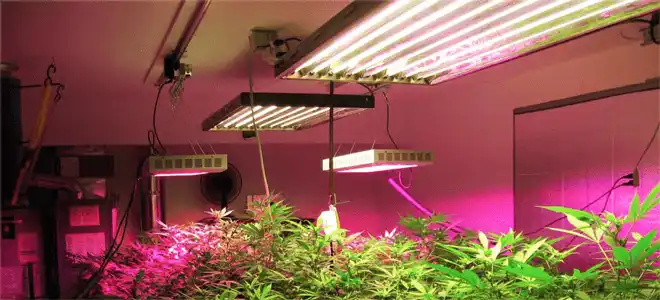
A dependable light cycle starts with consistent darkness.
For photoperiod-dependent cannabis, an indoor schedule of 12 hours of light and 12 hours of uninterrupted darkness is the conventional way to initiate and maintain flowering. It's a practical baseline, not a universal biological ceiling or a guaranteed high-yield formula.
Illustrative daily timelines. The actual on/off clock times can shift to suit temperature management and equipment operation.
12/12 is the standard starting point
Keep the dark period predictable
Choose coverage over a fixture myth
Nighttime operation can help with heat
Is an advanced nine-week schedule better?
Some flowering schedules progressively shorten daylight from 11 to 9 hours over nine weeks and promise larger harvests, lower costs or faster results. Those benefits are not established for cannabis cultivars generally. A shorter photoperiod can reduce daily lighting hours, but also reduces the light energy plants receive; lower electricity use does not automatically mean a better harvest or lower cost per unit produced.
Controlled-environment studies have found that some cultivars can flower under periods longer than 12 hours and respond differently to changing daylength. A 2023 study of ten cultivars observed flowering initiation under light periods of up to 14 hours, but development and harvest responses differed by cultivar. It does not validate a universal nine-week countdown or guaranteed savings.
For an ordinary indoor setup, maintain the stable 12/12 schedule while tracking plant condition, canopy light levels, temperature and cultivar-specific development. Do not change multiple variables at once expecting a guaranteed yield improvement.
Before switching to flowering
- Confirm the plant is photoperiod-dependent rather than autoflowering.
- Check the timer, fixture installation and safe electrical load.
- Check that the dark period is uninterrupted and the room can be ventilated safely.
- Monitor plants for several days and keep the daily schedule consistent.