
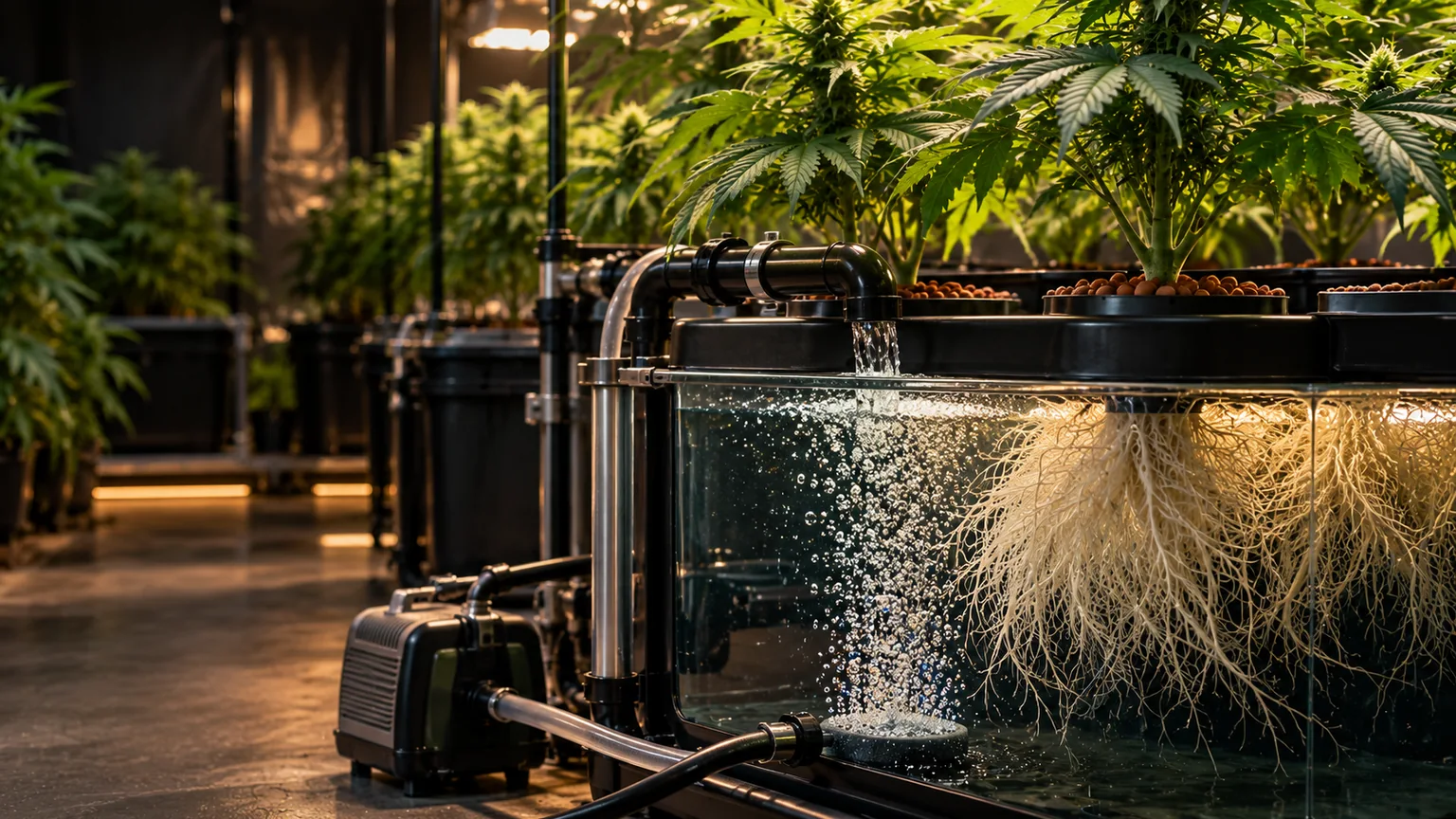
Hydroponics works when roots receive water, dissolved nutrients and enough oxygen. The equipment differs mainly in how solution reaches the roots and how air stays available. There is no universally fastest or highest-yielding hydroponic system: roots, crop size, environment and maintenance all matter.
Three ways water reaches the root zone
The clearest way to understand any hydroponic setup is to follow the water. Where is it held, when does it move, and where do roots get oxygen?
Flood and drain
A pump fills a growing tray or bottom-fed buckets. When the pump stops, the solution drains away and air moves back into the root-zone pore spaces. A timer, overflow and unobstructed return are essential.
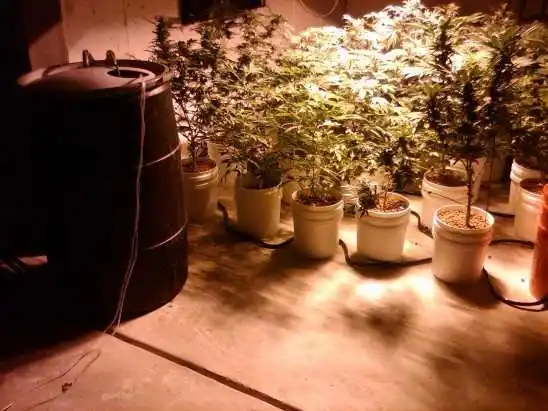 See the flood-and-drain cycle
Deep water culture
Roots remain in a nutrient solution that must be sufficiently oxygenated. An air pump and diffuser maintain aeration; water temperature, oxygen availability and pump outages need particular attention.
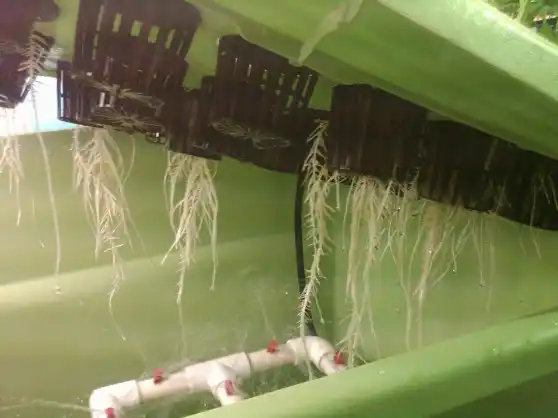 Understand aeration needs
Air-driven table systems
Some designs use air pressure rather than a conventional submersible feed pump to move the solution into a tray. Their valves, controller and return path are system-specific. This is a variation in fluid delivery, not a separate requirement for plant nutrition.
 Compare room layouts
Moves nutrient solution to a flood table, emitter or return circuit. A working motor does not prove each outlet has flow.
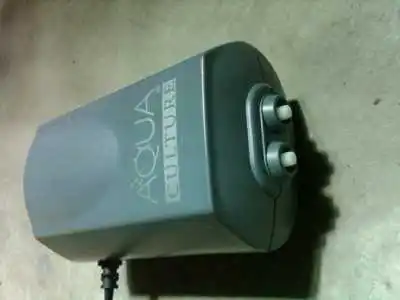
Pushes air through a diffuser to increase oxygen transfer and mixing in water. Bubbling does not replace checking root health, temperature or dissolved oxygen when it matters.
Why the roots need oxygen
Roots use oxygen for respiration. In moist media, drainage and pore space provide access to air; when roots are submerged, oxygen must remain available in the water. Warmer solutions hold less dissolved oxygen. An air stone can improve aeration, but it does not sterilize a reservoir or make algae impossible.
Check that water leaves the growing medium between cycles. Persistent standing water may reduce the air available to roots.
Inspect the diffuser and air supply, especially during warm conditions and after outages. Roots remain submerged rather than draining into open air.
Emitter flow and medium texture determine whether water reaches roots while leaving drainage and air spaces.
Reading the nutrient reservoir
The reservoir is a shared water and nutrient supply, not a fixed calendar. Plant uptake, evaporation, top-ups and recirculation all change what it contains. Measure the solution and investigate unexpected trends rather than assuming a universal percentage of nutrients disappears daily.
Water level
Check actual volume and top-up history. Concentration can rise when water is lost faster than dissolved salts, or fall after dilution.
EC / conductivity
EC estimates total dissolved ions; it does not identify which individual nutrients are missing or prove a formulation remains balanced.
pH
pH affects nutrient availability. Use a calibrated meter and crop-appropriate reference rather than correcting from leaf appearance alone.
Temperature and oxygen
Warm solution holds less oxygen. Watch heat, pump performance, root odor and unexpected cloudiness; sample dissolved oxygen where needed.
When should the reservoir be changed?
There is no universal seven-day flush rule. A change may be warranted when measurements, solution history, contamination, plant health or manufacturer instructions indicate the existing water cannot be brought back into range reliably. Keep tanks opaque or covered, clean between cycles, and inspect hoses and filters rather than relying on aeration alone.
For fertilizer principles, see Grow Nutrients; for root-zone salt buildup and evidence around preharvest practices, see Flushing Nutrients.
Hydroponic system examples
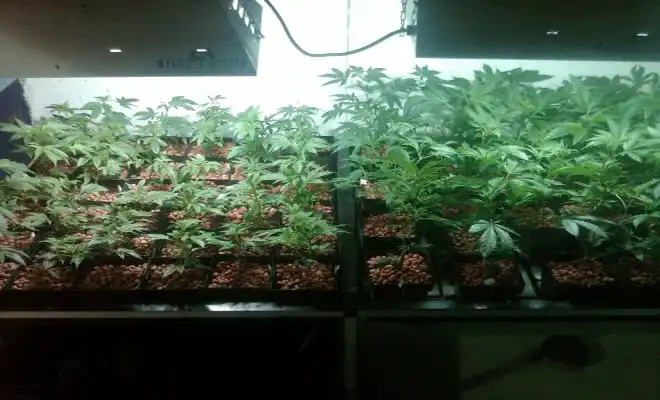
Grow-room equipment, containers and plumbing can look similar while operating differently. Identify the water path and root-zone aeration before following another grower's schedule.
Check the failure points first
No flow? Inspect the pump, intake, power, emitters and airlocks. A running motor can still deliver no water.
Slow return? Check a blocked fitting, kinked hose or insufficient downhill slope before increasing pumping.
Roots deteriorating? Inspect oxygenation, water temperature and sanitation, then confirm EC and pH rather than adding nutrients blindly.
Continue exploring
Further reading
Oregon State University Extension: Deep Water Culture, University of Missouri Extension: Hydroponic Nutrient Solutions, and University of Minnesota Extension: Small-Scale Hydroponics.
Existing equipment directory: Grow Room Supplies. For the substrate used in many flood and drip systems, see Soilless Growing Mediums.