
THE GROWING STAGE / ROOTS TO CANOPY
Build a healthy plant before asking it to flower.
Vegetative growth is when cannabis develops its root system, leaves, stems and branch structure. It begins after the fragile seedling or rooting-clone period, but there is no universal date when every plant enters or leaves it. A healthy root zone and a manageable canopy matter more than a calendar.
Four visible milestones, not four deadlines
Use changes in the plant to recognize development. The sequence is illustrative; cultivar, environment and propagation method affect timing.
- 01 / ESTABLISH
Roots take hold
New growth follows successful rooting or seedling establishment. Watch the medium and leaf posture, especially after a move.
- 02 / EXPAND
Leaf area increases
Fresh nodes and larger leaves expand the light-catching canopy. Water and nutrient demand change with new growth.
- 03 / SHAPE
Branches form a canopy
Internodes, branching and spacing determine how evenly light and air reach foliage. Inspect crowded and shaded areas.
- 04 / ASSESS
Ready for the next stage?
For photoperiod plants, evaluate health, canopy height and expected stretch before changing to flowering conditions.
These are structural milestones, not week-by-week growth forecasts. Autoflowering cultivars do not depend on the same deliberate photoperiod change.
Transplant when roots and foliage can support the move.
Established clones and seedlings can be moved into a larger container when the root plug holds together and fresh growth is evident. Prepare an appropriate, draining medium; handle the root ball rather than pulling on the stem. Set the plant at a suitable depth, avoid crushing roots, water in according to the medium and allow it to recover before making several other changes.
There is no universal one-hour soak or pH 6.0 rule for rockwool, soil and other substrates. Follow the substrate manufacturer's conditioning guidance, test the actual water or solution where relevant, and avoid saturating the root zone simply to satisfy a formula. Oxygen availability matters alongside moisture. See rooted cloning, seedling growth, germination and seed fundamentals.

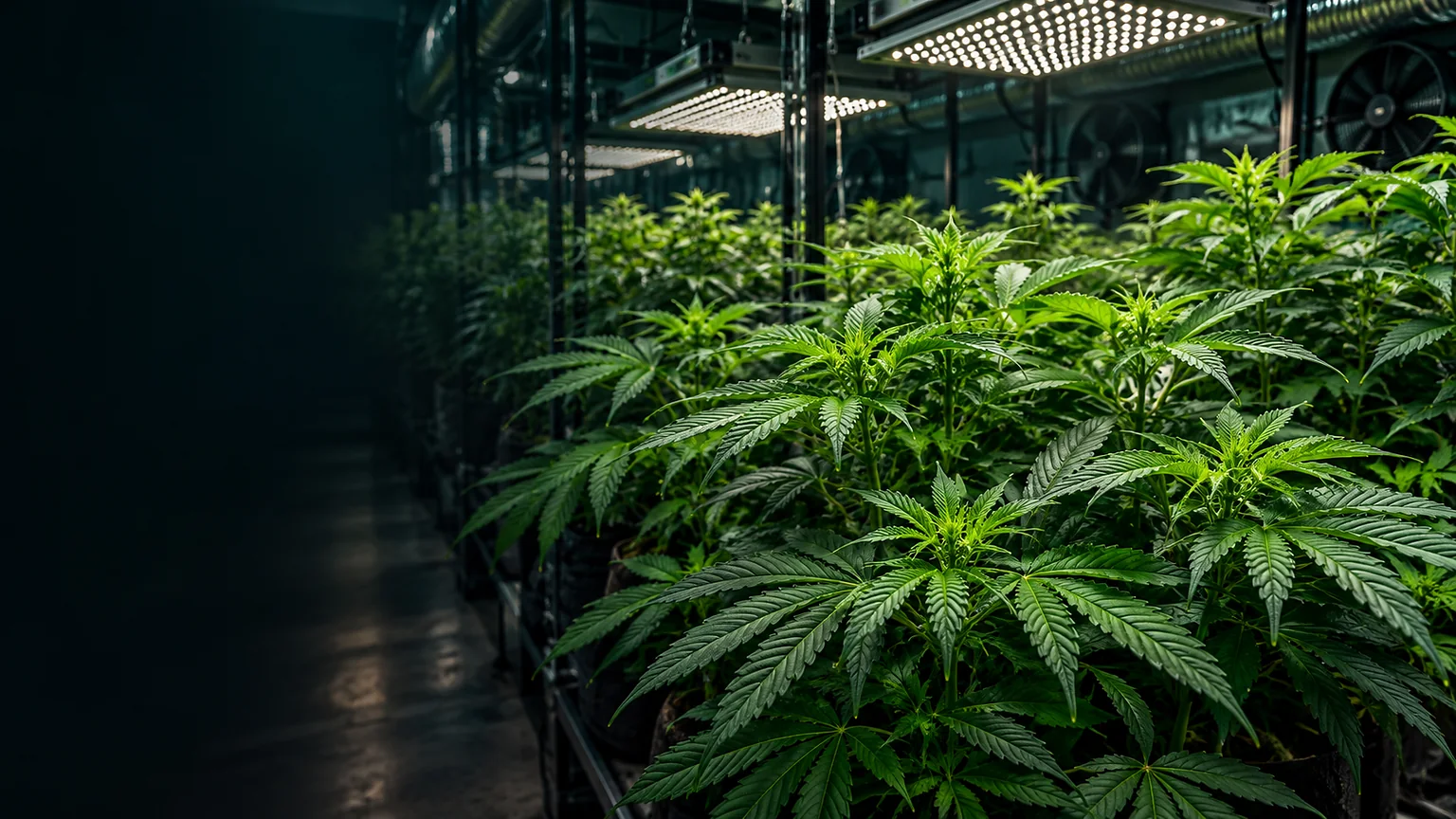
A photograph from this grow's vegetative stage, retained as an example of one setup.
Think in canopy light and day length, not lamp wattage.
Indoor photoperiod cannabis is commonly kept in vegetative growth with long days, often 18 hours of light and 6 hours of darkness. For photoperiod cultivars, a consistent shorter day commonly initiates flowering; autoflowers respond differently. Lamp choice alone does not determine plant health.
Modern LED and conventional discharge fixtures can both illuminate a canopy. Compare measured light at leaf height, fixture coverage, daily duration, electricity use, heat and actual plant response. A 250 W → 400 W → 1000 W metal-halide progression is not a general prescription. Explore the light-cycle guide, grow lighting and grow-room layouts.
The grower described using continuous light and several metal-halide fixtures in a warehouse setting. That describes the equipment used there; it does not establish that 24-hour lighting is necessary or superior for other plants.

A lighting photograph associated with the original grow notes; use measured canopy conditions to evaluate a contemporary setup.
Support new growth without chasing a universal feed recipe.
As roots and leaf area expand, water and mineral demand usually increase. Nitrogen supports new foliage, but healthy vegetative growth still depends on balanced nutrition, adequate oxygen and the condition of the medium. Too much fertilizer can add salt stress without improving growth. In soil, soilless media and recirculating hydroponics, appropriate solution strength and pH management differ.
Start with the relevant feed-label and substrate instructions, measure where your system allows, and compare changes in leaves and water uptake over time before adjusting. For deeper reference, use the nutrient library, N–P–K fundamentals and Grow Room Builder.
A vigorous canopy still needs airflow and inspection access.
Leaves and branching
Watch internode spacing, fresh leaves and whether lower branches stay excessively shaded.
Moisture and drainage
Observe how quickly the medium dries and whether roots remain well aerated.
Temperature and air
Maintain conditions within the cultivar and equipment's workable range; do not let dense foliage block air circulation.
Stress and pests
Inspect leaf undersides, growing tips and problem spots before assuming every change is a nutrient deficiency.
06 / FOLLOW A REAL GROW
Four chapters through vegetative growth
The week labels belong to one grow journal. They are a way to follow plant development and decisions, not fixed instructions for every cultivar.
07 / THE HANDOFF
When should the plant enter flowering?
For a photoperiod cultivar, the choice depends on the grow's goals and the available room, not a mandatory vegetation duration. Assess the plant before initiating a consistent flowering light schedule.
- New growth is healthy and the root zone is stable.
- The canopy has enough headroom for cultivar-dependent stretch.
- Watering, light coverage and circulation can support more growth.
- There is no unresolved pest or environmental problem being ignored.
CONTINUE EXPLORING
Find the guide for the decision in front of you.
Further reading: University of Saskatchewan — Vegetative Growth; Moher et al. — Cannabis light intensity and plant architecture; UF/IFAS — Supplemental lighting and hemp flowering.