
Plant health / The inspection guide
Look underneath the damage.
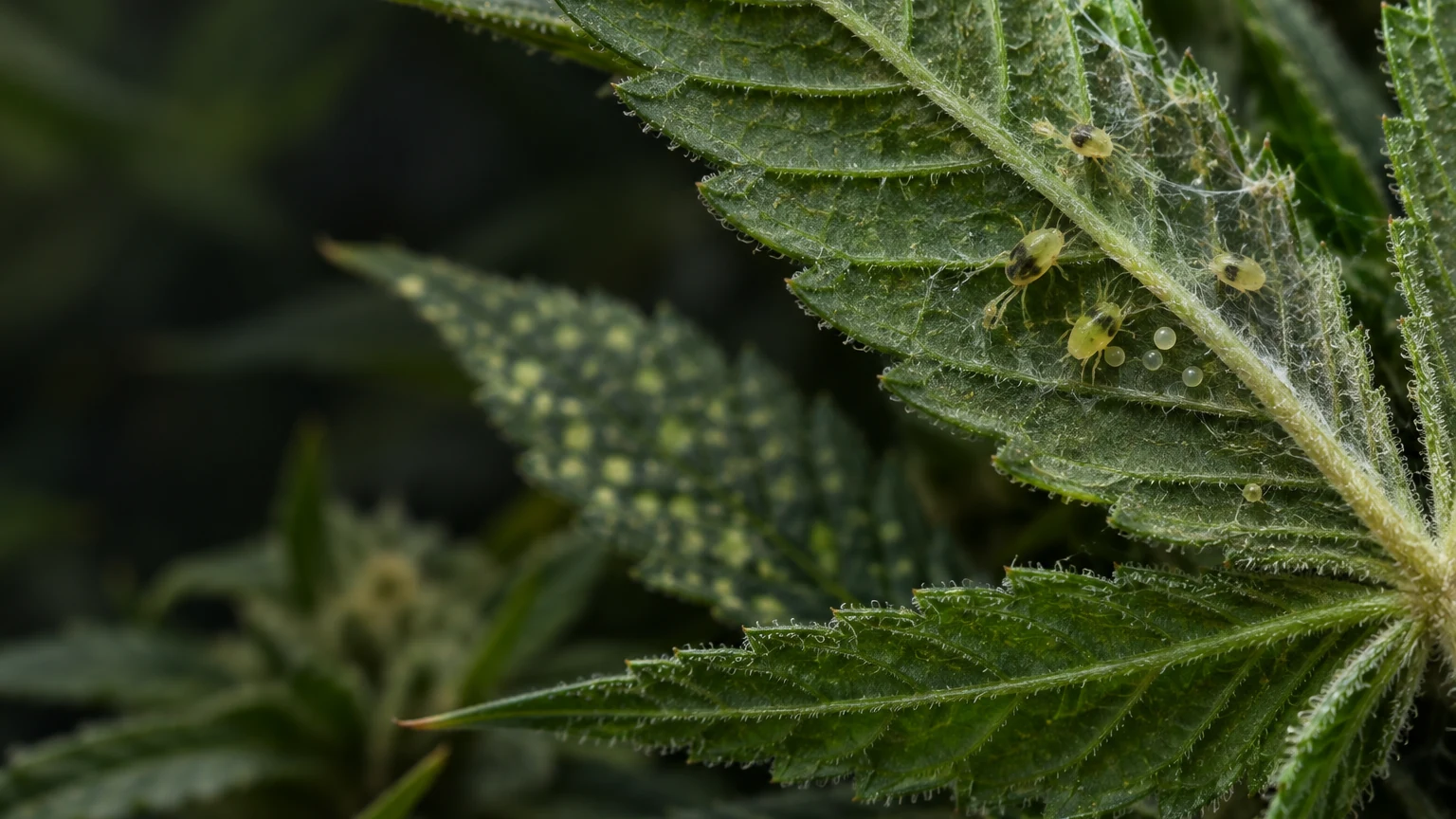
Spider mites can damage cannabis leaves before the infestation is obvious. Look for pale stippling, inspect leaf undersides with a hand lens, and check for fine webbing as populations grow. Finding them early gives you more options, especially in indoor marijuana grow rooms where plants are close together.
01 / Read the evidence
Three things to look for.
Open each sign for the next check. Confirm what is on the plant before choosing a control.
A / Leaf surfacePale stipplingInspect the pattern
Small pale dots can be feeding damage. Turn the affected leaf over and look for mites or eggs; stippling alone does not confirm the cause.
B / Leaf undersideMites & eggsLook closer
Use a hand lens to look for moving mites, translucent eggs and shed skins. Adult spider mites have eight legs. Their color varies, so use more than color to identify them.
C / Undersides & tipsFine webbingCheck the extent
Fine silk can accompany a more developed infestation. Check nearby plants and whether flowers are affected. Heavily webbed flowers need particular caution.
Read the flowering-plant cautions →Illustrations are not to scale. Check the plant with magnification.
Magnification matters
What are Spider Mites?
Spider mites are arachnids, not insects, and are closely related to spiders and ticks. Adults have eight legs and are difficult to identify without a hand lens. Look beneath affected leaves with 10× magnification for moving mites, translucent eggs and shed skins. Two-spotted spider mites are common on cultivated plants; their color varies, so do not diagnose them by color alone.
Inspect several leaves.
Look beyond a single spot.
Use a hand lens on leaf undersides.
Legs on an adult spider mite. Color varies.
Connect the signs
How Spider Mites Damage Marijuana Plants
Spider mites pierce leaf cells and feed on their contents, leaving pale dots called stippling. As populations grow, leaves may turn yellow or bronze, dry out and drop. Fine silk on leaf undersides or growing tips usually signals a more developed infestation. Stippling alone is not proof: confirm living mites or eggs before choosing a treatment.
Finding eggs does not automatically mean the entire crop must be discarded. Check several leaves on each plant, monitor whether the population is increasing and act promptly. Heavy webbing or contamination of flowers is much harder to manage; remove severely affected material rather than assuming it can be made safe to consume.

At the plant
Keep a clear set of observations.
Use the checklist for each affected plant, then compare nearby plants. The guidance below stays available as you work.
02 / Work through the response
Controlling Spider Mite Infested Gardens
Confirm and separate.
Confirm an active infestation on leaf undersides before choosing a control. Inspect nearby plants and separate affected material when practical.
Clean the growing area.
Clean growing tools and benches, remove infested plant debris and inspect new plants before introducing them to the room. Pay particular attention to the undersides of leaves and nearby plants. Good hygiene lowers the risk of reintroduction, but cleaning the room alone will not eliminate an active infestation on plants.
Review controls and crop restrictions.
Some growers consider miticide spray or products such as Azamax by General Hydroponics, but their presence here is not a recommendation or proof of approval for cannabis. Where suitable, carefully washing leaf undersides or using compatible predatory mites can help. If a pesticide is necessary, use only a product permitted for the crop and application site, and follow its current label.
03 / Before any treatment
The application site matters.
Read the reservoir restriction.
Do not add miticide to a hydroponic nutrient reservoir or flood plant roots with it unless the current product label explicitly authorizes that application for the crop and system. Spider mites generally feed on leaves, not roots. Follow labeled directions for application method, crop, dilution, personal protection and harvest restrictions; do not improvise a reservoir treatment or fixed spray interval.
Protect consumable flowers.
Be especially cautious with infested flowering plants. Oils and sprays can damage sensitive tissue or leave unwanted residues, and not every product may legally be used on cannabis flowers. Do not spray consumable buds based on general houseplant advice. When flowers are heavily webbed or contaminated, discard affected material rather than treating appearance as proof of safety.
