
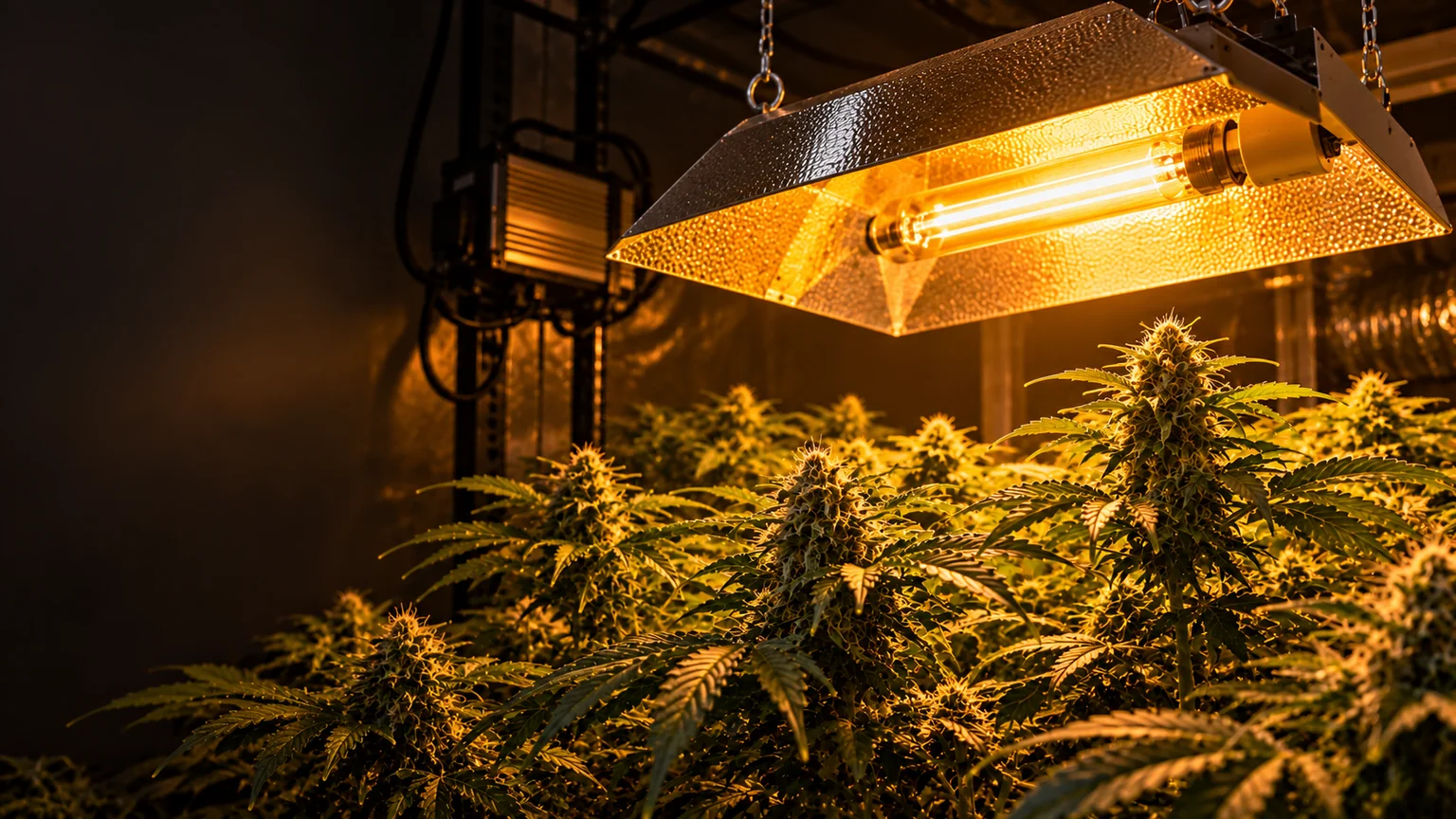
What an HPS grow light actually does well
High-pressure sodium lamps can deliver substantial light across flowering canopies, especially in rooms already designed around their fixtures. But a powerful bulb is only one part of the system: reflector geometry, ballast compatibility, heat removal and the light reaching the leaves determine whether it is practical.
An HPS fixture is a four-part system
Unlike a household bulb, an HPS lamp needs a compatible ballast to ignite and regulate the discharge. Its reflector shapes where photons land, while suspension and ventilation determine how safely it can operate. Every part must match the manufacturer’s specifications.
Lamp
Choose a lamp type and wattage approved for the ballast and socket. HPS light appears warm orange, but color alone does not indicate crop performance.
Ballast
Check the exact lamp/ballast pairing, input voltage, plug and dimming compatibility. Never improvise electrical connections.
Reflector
Compare canopy distribution and height requirements, not only polished metal or advertising claims.
Cooling
Account for fixture surface temperature, plant clearance, ducting and the room's HVAC load.
One 1,000W bulb does not define a plant count
A single fixture may cover different canopy areas depending on its reflector, hanging height, overlap with adjacent fixtures, movement along a light rail and the crop's structure. A claim such as “12 plants per lamp” has no transferable meaning without plant spacing, the canopy area and measured PPFD across it.
Measure the full canopy
Compare PPFD readings or a reputable fixture map at the actual planned mounting height. Check edges as well as the bright center; consider daily light integral over the complete schedule.
Leave real clearance
Radiant heat and hot reflectors can stress upper leaves. Follow fixture installation instructions, measure canopy temperature and keep hot components away from covers, cables and combustible material.
When HPS still earns a place — and when LED wins
HPS can be reasonable
Functional fixtures can make sense in a room already sized for their heat, vertical clearance, and electrical demand. Check lamp condition, ballast age and measured canopy light before assuming replacement is necessary.
Evaluate efficient LEDs
Modern horticultural LEDs often deliver more usable photons per joule and distribute them with less radiated heat toward leaves. Compare independently measured efficacy, total PPF, PPFD maps and total ownership cost rather than assuming either technology always wins.
For technology comparison, use the LED Grow Lights guide; for fixture installation and canopy layouts, see Indoor Marijuana Grow Lights. The Grow Room Builder helps plan space and ventilation.
Ballasts, bulb replacement and safer operation
- Verify before energizing. Use the listed lamp/socket/ballast combination, correct supply voltage, manufacturer-approved mounting and strain relief. Treat damaged wiring, noisy failing ballasts and loose connections as service issues.
- Keep heat and moisture apart. Secure fixtures with rated supports, maintain specified clearance, and keep irrigation spray and wet hands away from electrical equipment.
- Track output, not harvest count. A six-month replacement schedule is one grower's practice, not a universal rule. Follow rated service life and evaluate dimming, color shifts or measured performance with suitable instrumentation.
- Handle spent lamps properly. HPS discharge lamps may contain hazardous materials; follow local recycling rules and do not discard damaged lamps as ordinary unexamined waste.
Used fixtures are not automatically unsafe, but inspect condition and compatibility carefully; avoid damaged or undocumented electrical equipment. Never work inside an energized ballast or hot fixture.
The Hydrofarm and Hortilux setup
A grow-room example on this site used 1,000W Hydrofarm HPS fixtures, Hortilux Super HPS lamps and light-rail motors. The grower ran lights 12 hours daily during flowering and described favorable results over many years. That experience establishes how one room operated; it does not prove that 1,000W, a particular brand, 12 plants per light, or frequent bulb replacement are optimal for other spaces.

Existing HPS lighting photograph
Check the actual ballast, fixture, reflector and lamp specifications when evaluating equipment similar to this setup. Equipment condition and measured canopy coverage matter more than a nominal wattage label.