
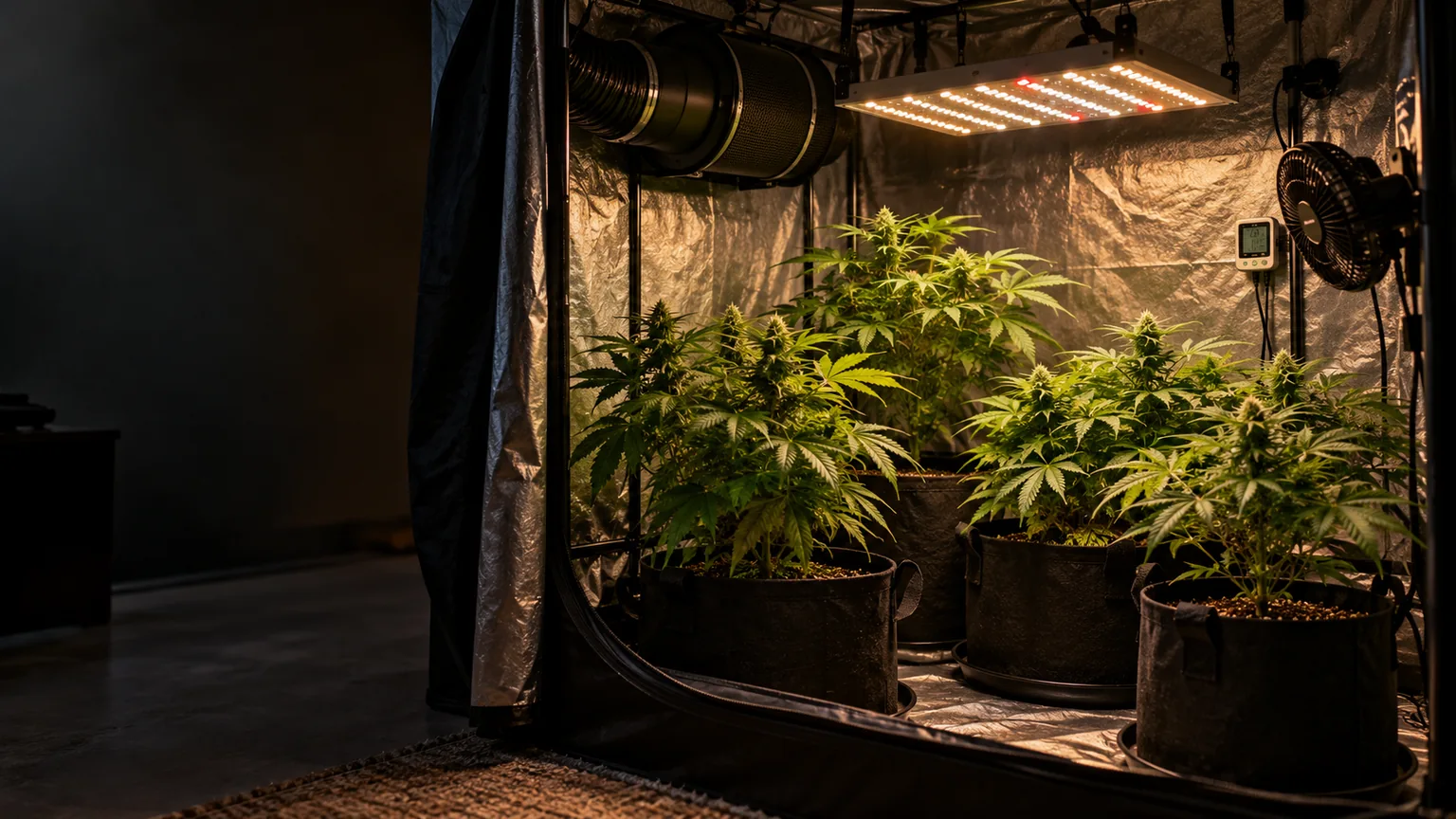
A successful indoor setup is not a contest to fit the most plants or hardware into a room. Give your plants a manageable environment, give yourself room to work, and learn how each part of the setup affects the others.
Before purchasing equipment, confirm local cultivation, tenancy, electrical and fire-safety requirements. This guide describes growing principles; lawful plant counts and building rules depend on your location.
Start with a space you can actually maintain
A tent, closet or dedicated room can all work. For a first grow, a small, accessible area often makes it easier to spot problems and control conditions than a room packed wall to wall. Account for mature plant height, light-to-canopy clearance, ducting, water access and where you will stand to inspect plants.
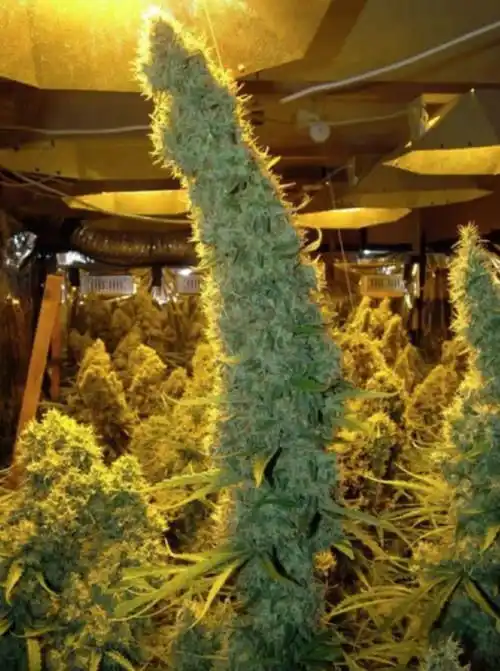
Need more room-planning detail? See indoor grow room design, accessible layout planning, and the Grow Room Builder.
Choose a light by coverage, efficiency and mounting clearance
A modern LED fixture is a practical starting point for many small grows, but the right choice depends on the canopy area, measured light distribution and heat that the room can remove. Look for credible PPFD coverage data, dimming, suitable environmental ratings and a safe mounting method. A fixture's wattage by itself does not tell you how evenly it lights plants.
Usually the most straightforward modern option: efficient, dimmable models are widely available. Still account for fixture heat, height and airflow.
HID systems can grow plants but generally produce more radiant heat and require compatible lamps, ballasts, reflectors and additional clearance. They are not mandatory.
Useful for some propagation and small-scale applications, but not an automatic bargain for a full flowering canopy.
Use the manufacturer's hanging and photometric guidance, measure at canopy height where possible, and adjust gradually to avoid stress. Continue with grow lights, lighting troubleshooting and safe hangers and mounting.
Separate air exchange from circulation
An exhaust system removes warm, humid air; replacement air enters through a suitable intake. Separate circulating fans keep pockets of still air from forming around foliage. Neither job can be judged reliably by room size alone: fan curves, duct restrictions, filters, ambient climate and lighting load all matter.
Monitor temperature and relative humidity over the entire light/dark cycle, not only at a single comfortable reading. Humidity-related mold risk rises when wet plant surfaces persist. Follow the ventilation guide for equipment selection and troubleshooting.
Put lighting and environmental checks on a routine
Use a properly rated timer or controller for the lighting schedule. Many photoperiod varieties are grown with an extended day during vegetative growth, then a reliable 12-hour dark interval to initiate flowering. Autoflowering varieties differ and do not require a 12/12 switch to flower. Consistency matters more than a supposedly universal “perfect” schedule.
Keep controls and connections clear of splashes. A temperature/humidity logger is usually more useful to beginners than an elaborate CO₂ system. For access and sensor planning, see room monitoring and security.
Pick one growing medium and learn its watering behavior
Good plant growth depends on oxygen, moisture and appropriate nutrition around the roots. Potting mixes, coco coir and hydroponic media manage these differently. None guarantees faster or larger yields by itself.
A forgiving first choice when the mix drains well; some blends already contain fertilizer. Follow the mix's instructions rather than stacking nutrients on top.
A soilless medium that requires a suitable nutrient program and attention to irrigation, drainage and calcium/magnesium balance.
Offer direct control of nutrient solution but demand closer observation of pH, oxygenation, leaks and system reliability.
Compare options in soilless growing mediums and hydroponic systems before buying specialized equipment.
Choose containers that drain and stay serviceable
Container size should suit the plant's anticipated root mass, the medium and your ability to lift and inspect it. More volume is not always better; an oversized wet container may dry slowly, while an undersized one can demand frequent watering. Fabric pots, rigid pots and hydroponic net pots each have different tradeoffs.
Feed according to the medium and the plant
Nitrogen, phosphorus and potassium (N–P–K) are primary macronutrients. Calcium, magnesium and sulfur are secondary macronutrients; elements such as iron and copper are needed in much smaller amounts. Most complete nutrient programs account for all of them. Feeding every week or always at “half-strength” is not a universal rule.
Start with your medium and fertilizer manufacturer's directions, check water quality and monitor the response. If plants show pale or damaged leaves, first review moisture, root condition, pH and environmental stress rather than immediately adding another supplement. Learn more in the nutrient guide and plant and leaf deficiencies.
Water by what the roots need—not the calendar
Check the medium's moisture and the container's weight before irrigating. Water thoroughly enough for your medium and method, then provide appropriate drainage. Avoid leaving plants continuously saturated and do not deliberately wait for severe wilting as a routine signal: by then the plant may already be stressed.
Verify the timer, light height, temperature, humidity, root-zone moisture and pH where relevant. Change one variable at a time and keep notes. A dependable routine prevents more problems than an ever-growing equipment list.
Build the next part of your grow
Also explore clone machines and nutrient product context.