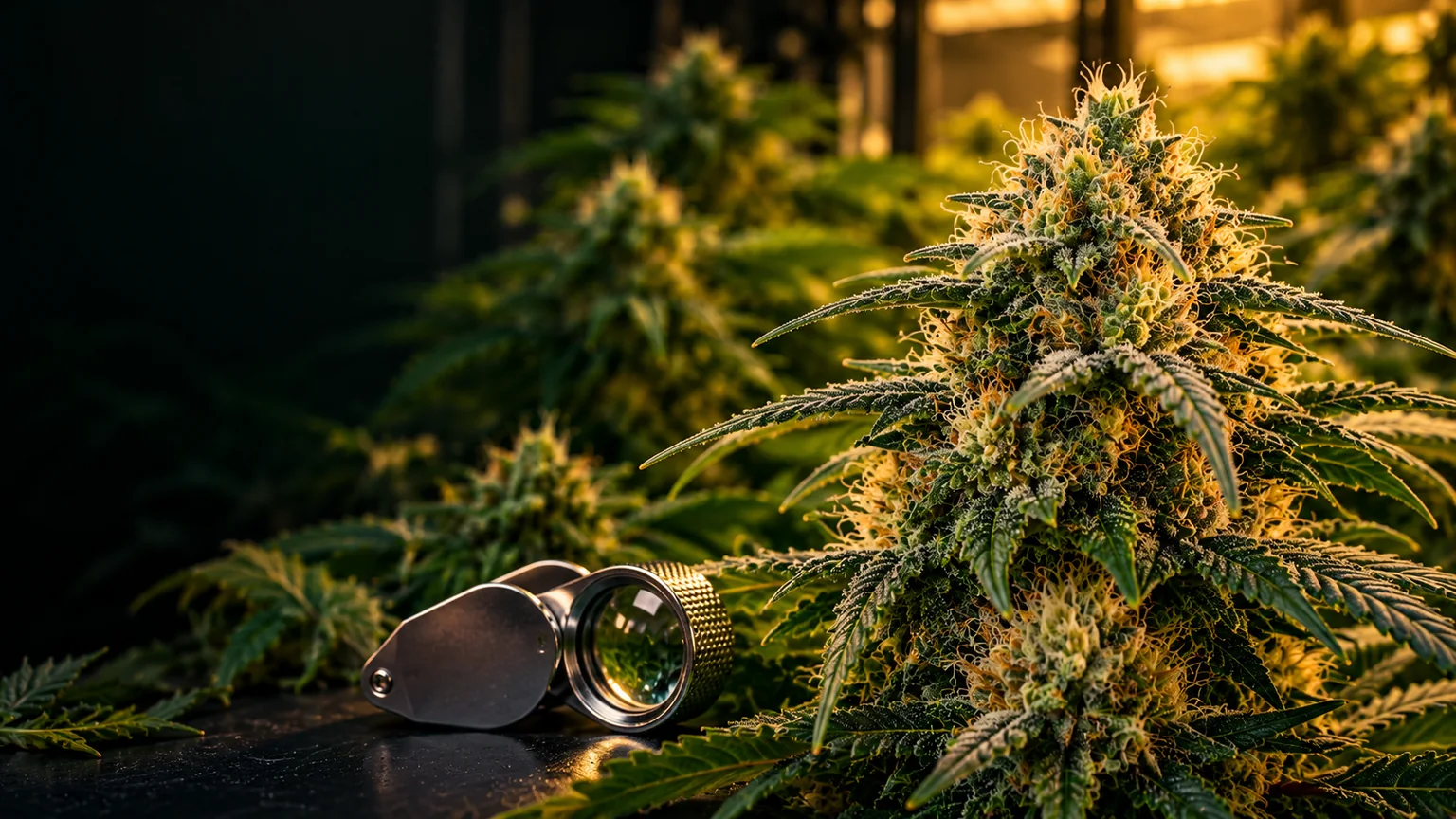
Flowering week six calls for inspecting the actual buds and maturity signs, not a fixed harvest date: assess flower trichomes, prevent mold, preserve clean handling and decide whether to continue flowering.
FLOWERING WEEK 6 / FIELD NOTES
Assessing maturity without racing the calendar
Some fast-flowering plants may approach harvest in week six; many others will continue building their flowers. Learn what to observe, how to use magnification responsibly, and how to keep the harvest decision tied to the actual plant rather than a preset threshold.
01Whole flowers
Check whether bud clusters are still developing.
02Magnification
Inspect several flower surfaces, not just a leaf.
03Flower health
Look for mold in dense interior buds.
04Harvest readiness
A numbered week alone never decides.
IN THIS GROW
A late-flowering cross observed up close
The grow journal describes a Matanuska Mint and Afghan #1 cross whose grower anticipated a relatively short flowering period. That expectation came from experience with that particular cross; it cannot define harvest timing for unrelated cultivars. Use several flower observations before making the call.
Compare the original strain against the real condition of this plant; a name or flowering estimate alone cannot establish maturity.
01 / FLOWER STRUCTURE
Is the plant still making new flower tissue?
Look at swelling bracts, clusters on more than one branch and the pace of new stigmas. Some plants continue flowering well after six weeks, especially when genetics and growing conditions differ from the grow journal. Brown or orange hairs alone do not prove that flowers have completed development.
02 / TRICHOME INSPECTION
Inspect bud trichomes in context
Use a clean handheld magnifier or loupe to compare glandular trichomes on the flower bracts at several sites. Sugar-leaf trichomes can mature differently and can mislead an otherwise careful inspection. Cloudiness and amber coloration are observations, not a validated one-size-fits-all percentage that guarantees potency or a particular effect. Laboratory analysis is needed to determine actual cannabinoid composition.
An optical loupe can help reveal visible structures; the original grow used a BelOMO loupe. Compare current BelOMO loupe listings on Amazon (paid link), or use another clear magnifier suitable for close inspection.
Examine dense interior flowers for brown-gray damaged tissue, a musty smell or other signs of bud rot. Keep airflow working, avoid wetting buds and support top-heavy branches. Do not try to salvage moldy cannabis for consumption. Late-flowering leaf fading is not by itself a reliable maturity test.
04 / THE HARVEST DECISION
Choose your timing from the plant, not a fixed trichome rule
Compare the breeder's expected range with the flowers' continued development and repeated inspections. If growing tips are still producing substantial new flowers, harvesting on week six just because the calendar says so may be premature. Conversely, a genuinely mature fast cultivar need not follow a longer plant's schedule. Keep records, note actual room conditions and avoid universal promises about amber trichomes.
A field-friendly reference that pairs this stage with the current FoxFarm soil schedule. Scale the recipe to your actual watering volume with the calculator instead of doing the math in the grow room.
Schedule values are a reference to the current FoxFarm soil chart, not a universal prescription for every cultivar, medium or environment.
HARVEST CHECKLIST
What deserves a final inspection
Several bud sites
Compare upper and lower flowers, not one sugar leaf.
Continuing flower growth
Note new bracts and fresh stigmas alongside older tissue.
Flower hygiene
Separate any suspicious or visibly moldy colas.
Handling and drying
Plan clean tools, safe ventilation and hygienic drying space before cutting.
AFTER FLOWERING
Continue flowering or prepare to harvest
There is no universal week-six finish line. Harvest only after assessing the specific plant, and prepare a clean, ventilated place to dry the flowers safely.
Use clean cutting and handling equipment.
Discard rather than process visibly moldy buds.
Arrange a controlled, sanitary drying area ahead of time.
For plants still developing, maintain stable care and keep observing.
Knowing when to harvest your cannabis plants for the marijuana buds is explained in simple form in this short video. Follow my instructions on how I determine if the thc trichomes are showing signs of being finished.
Cutting Marijuana Buds during Harvest
Once your marijuana plants are ready to harvest, you simply need to take a pair of scissors, gloves, trash bag or clipping table and begin to trim and remove all unnecessary water leaves and stems or branches. Once you have removed these, you simply cut each leaf in uniform manner which is known as Manicuring your bud plant. Watch this Video for detailed, easy to follow instructions on trimming and manicuring your bud plants during harvest.