
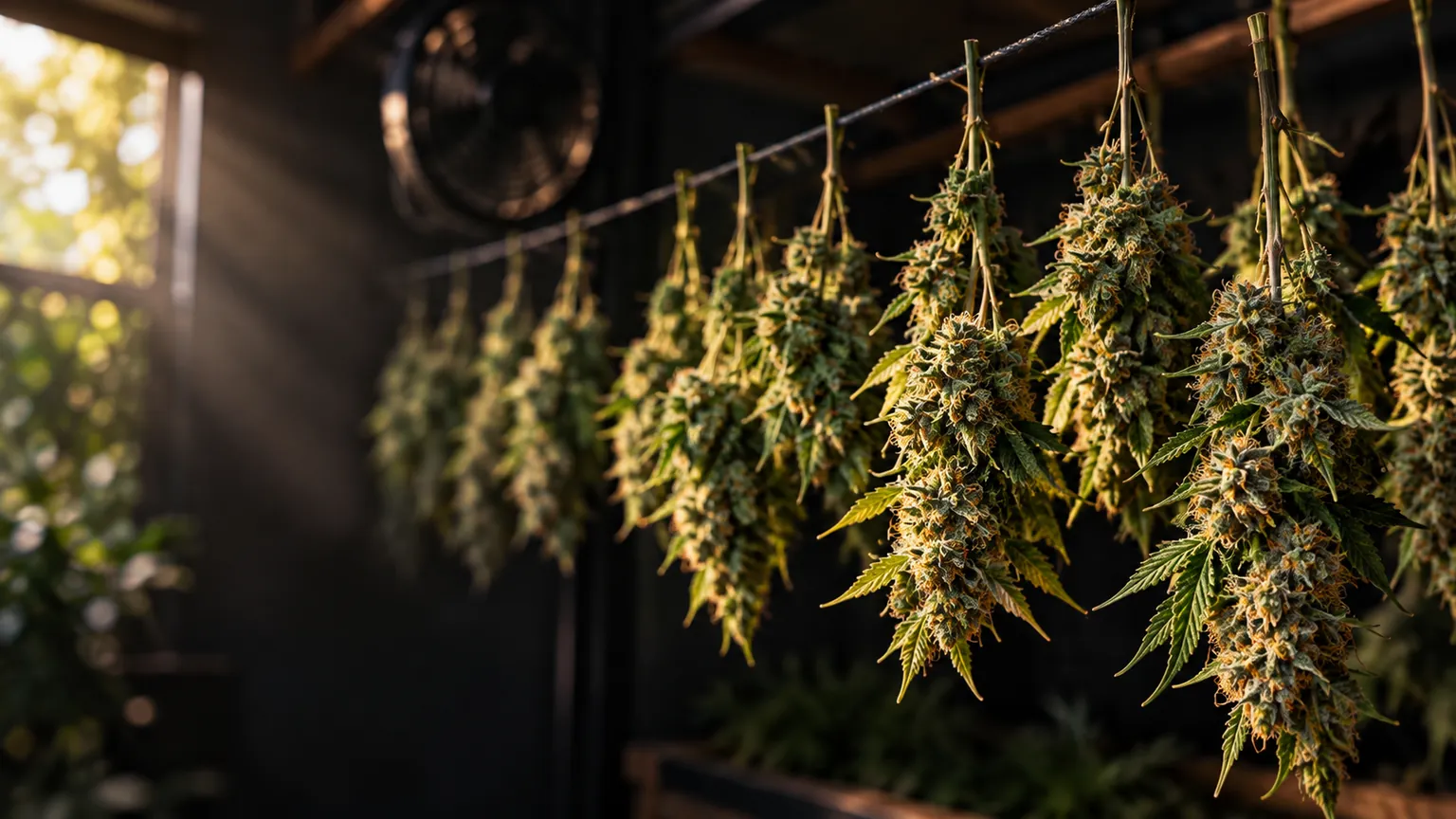
Hanging freshly harvested cannabis to dry removes moisture before long-term storage. Leave room around each branch, keep the space clean and dark, and move humid air out of the room without directing a fan at the flowers. A calendar alone cannot tell you when drying is complete.
Overlapping flowers can trap moisture. Give branches room and spread loose flowers across racks.
Gentle circulation and ventilation help move evaporated water away from the crop.
Look for condensation, persistent dampness, unexpected odors and visible mold.
How do you hang cannabis buds to dry?
Cut harvested material into manageable branches, remove obviously damaged or contaminated parts and suspend the branches from clean lines or hooks. Leave gaps between the flowers. The point is exposure to the surrounding air—not a hard stream of air hitting each bud. Handle cleanly and avoid letting branches touch walls or the floor.
From freshly cut to ready for storage
- Prepare the drying area. Clean surfaces, check the equipment, and confirm you can monitor temperature and relative humidity.
- Hang or spread the material. Use branches on lines or a single shallow layer on breathable racks; don't crowd the flowers.
- Manage moist air. Circulate air around the room and vent or dehumidify as conditions require, without blasting buds directly.
- Inspect daily. Check dense flower clusters as well as the room for damp spots, condensation or contamination.
- Assess before storing. Do not assume a stated number of days or one snapping stem proves that all flower is uniformly dry.
Hanging branches vs. drying racks
Best when branches have room
Suspending branches minimizes handling of individual flowers and leaves access around the material. Large dense branches need particular attention so interior buds do not stay damp.
Useful for loose, trimmed flower
Breathable racks help when hanging space is limited. Distribute material in a shallow layer, prevent contact between dense clusters and check surfaces touching the mesh.

What conditions matter in a drying room?
Temperature, relative humidity, plant density and ventilation all affect how quickly moisture leaves flowers. A closet can work only if those conditions can be controlled. A closed, damp closet invites condensation; a fan blowing directly into the flowers can dry exposed surfaces faster than the interior. The right approach depends on the room, the material and the actual measurements.
Control moisture, not just air movement
Use a hygrometer to observe room conditions. Where needed, manage humid air with appropriate ventilation or dehumidification. Keep electrical equipment clear of wet areas and follow its safety instructions.
Drying is not curing
Drying removes substantial water from cut plant material. Curing is the later controlled-storage stage, after suitable drying. Sealing flowers that still contain excess moisture can encourage microbial growth.
A useful starting range—not a promise
The University of Saskatchewan's drying guidance describes roughly 16–23°C (61–73°F) and 50–60% relative humidity as workable room conditions. Treat these as a starting reference, not a setting that guarantees drying speed, flower quality or mold prevention. Flower size, room loading and actual air exchange still matter.
Cooler conditions may slow moisture removal. Excess heat may accelerate uneven drying and volatile aroma loss.
Watch for sustained changes and damp spots. One sensor reading cannot represent every dense flower cluster.
Allow moist air to leave the space. Do not aim an aggressive fan at flowers or pack branches together.
Measure near flower height, away from direct fan blasts, humidifier output or a hot light. Recheck readings when doors open, the weather shifts or freshly cut material is added. Record what changed rather than chasing one perfect number.
What the room is telling you
Use observations to investigate conditions, not to declare flower safe. Respond to the room and inspect dense flowers separately.
Humidity stays elevated or condensation appears
The room may be retaining more moisture than its ventilation or dehumidification can remove.
Check the hygrometer and walls, examine crowded clusters, improve measured air exchange and reduce crowding. Inspect for mold; never assume increased airflow can make contaminated flower usable.
Exposed edges become brittle while centers feel damp
Direct fan exposure or unevenly spaced material can create a misleading dry surface.
Redirect fans to circulate room air, check branch spacing and compare samples from sheltered and exposed positions. Do not seal damp material.
One rack or corner dries differently
Blocked airflow, overlapping flower or sensor placement may hide local differences.
Compare readings across locations, look for touching buds and inspect the densest clusters rather than relying on one easy-to-reach sample.
Visible mold, fuzzy growth or persistent musty odor
Appearance and smell can flag contamination but cannot rule it out when absent.
Isolate affected material and discard contaminated flower. Do not smoke it, trim away the visible patch or attempt to make it safe by drying further.
Before flower leaves the drying room
Compare, don't guess
Inspect several buds from dense and open areas. Check texture and moisture uniformity; a single stem snap is not a reliable test.
Understand your measurements
Room relative humidity measures the surrounding air. Moisture content describes water in the material. Water activity (aw) measures the water available to microorganisms. They are not interchangeable.
Store only after suitable drying
Drying time depends on the material. For safety-critical or commercial storage decisions, use appropriate validated water-activity or moisture tests and applicable contamination testing; a room hygrometer cannot certify safety.
Daily observation checklistOpen field notes
Write down the same observations at consistent times. Trends and differences between locations matter more than a single perfect reading.
- Room temperature and RH, including the time and sensor position
- Fresh-air exchange, fan direction and any equipment changes
- Spacing and moisture differences across dense and exposed flowers
- Visible condensation, abnormal odor or signs of contamination
- What you adjusted, then what changed at the next check
A dry-room hygrometer cannot replace a flower water-activity test. AOAC's cannabis microbiology guidance explains why water activity matters for microbial risk during storage.
How long does hanging flower take to dry?
There is no dependable universal three-to-six-day rule. Branch size, flower density, ambient conditions and airflow change the timeline. A small stem's snap is at most a rough observation, not a measurement of water activity inside the flower. For safety-sensitive or commercial decisions, use validated moisture or water-activity measurements and follow applicable testing requirements.
Do not store visibly contaminated flower
Inspect for visible mold and musty or abnormal odors. Contaminated material should be discarded; trimming a moldy spot or continuing to dry does not make it safe.
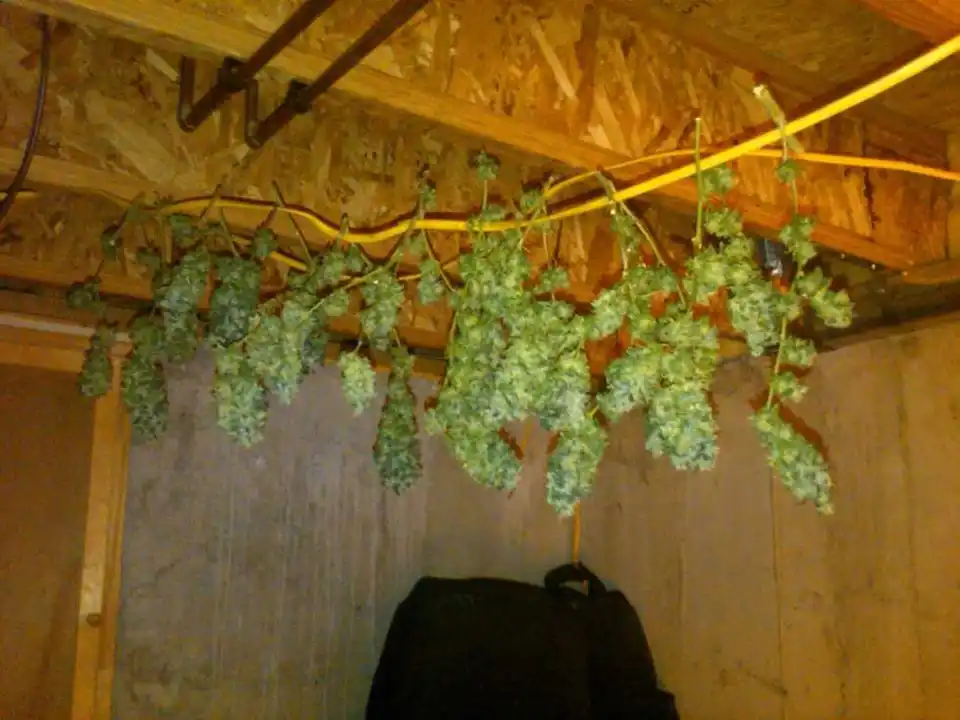
Spacing matters more than a fixed schedule
Hanging lines make it easy to separate branches, but closely packed flower clusters can still retain moisture. Walk the drying area and check the densest sections as conditions change.
Continue through harvest and postharvest care
Further reading: University of Saskatchewan drying guidance, New York State drying-room environmental guidance, University of Vermont Extension, and Vermont guidance on contaminants.