

The essentials
What are marijuana edibles?
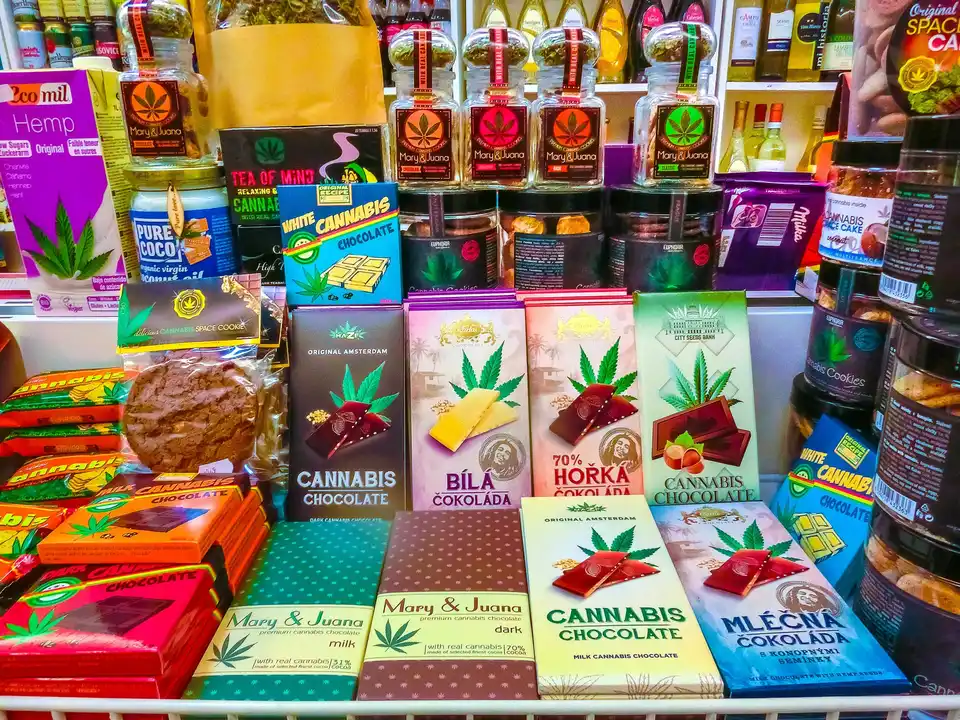
Marijuana edibles are foods and drinks containing cannabis, including gummies, chocolate, baked goods and beverages. THC-containing edibles can cause intoxication. Their effects can be delayed and long-lasting; the food's size, flavor or appearance cannot tell you its potency.
Start with the format. Then check the label, allow for uncertainty and plan for impairment.
01 / Know the format
Compare common edible formats
The carrier tells you how a product is consumed, not how strong it is. Compare all three groups, or focus on one.
Foods
- Gummies & candy
- Check THC per piece, per labeled serving and per package. One gummy is not automatically one serving, and a small candy is not necessarily weak.
- Chocolate & baked goods
- Find out whether the label refers to a whole bar or brownie, a marked segment or another portion. Equal-looking cuts do not prove equal THC distribution, especially in homemade food.
- For either format
- Read ingredients and allergen information too. Appearance and familiar flavors cannot identify cannabis content.
Drinks
- What to check
- Separate the liquid volume from the cannabinoid amount. A can or bottle may contain more than one labeled serving. Check for THC, CBD, alcohol and other ingredients.
- What to avoid assuming
- “Alcohol-free” does not mean non-intoxicating. “Fast-acting” does not promise the same onset for everyone, or establish when the full effect has arrived.
Other oral products
- Capsules, oils & tinctures
- These are not all foods or interchangeable products. Check the intended route: swallowed products and products used under the tongue can have different instructions.
- The container is not an instruction
- A dropper bottle does not establish concentration or suitability for cooking. Do not put an oil intended for another use into food.
02 / Understand the delay
First effects are not full effects
Swallowed cannabis is absorbed through digestion. Food in the stomach, the product, the amount consumed and other substances can change the experience. The CDC warns that this delay can lead people to consume too much before realizing how strongly it affects them.
- First effects
Often delayed
Health Canada's consumer guidance describes 30 minutes to 2 hours before effects begin after ingestion. Feeling little initially does not establish that a product is weak.
- Full effects
Can build for hours
The same guidance says full effects can take up to 4 hours. Taking more before they develop can increase the risk of unwanted effects.
- Lasting effects
May outlast the occasion
Effects can last up to 12 hours, with some residual effects lasting up to 24 hours. Those figures are broad guidance, not a personal prediction or a guaranteed end point.
Source: Health Canada: ingestion and effects. Do not take more just because you have not felt effects yet. These ranges are not a redosing schedule. There is no universal onset or duration for a gummy, brownie or drink.
A clock cannot clear you to drive. Health Canada states there is no standard waiting time for driving after cannabis use.
03 / Read the numbers
A package, a serving and a piece can differ
Find the named cannabinoid, the amount in milligrams (mg), the labeled serving size and the number of servings in the container. Read THC and CBD separately. A ratio alone, such as 1:1, does not tell you how many milligrams are present.
- THC in the package
- 20 mg
- Labeled equal servings
- 4
- THC per labeled serving
- 5 mg
20 mg ÷ 4 labeled servings = 5 mg per labeled serving
This is arithmetic, not a recommended dose or a tested product. The label still needs to define a serving: one piece, part of a piece or a measured liquid volume. It does not follow that the whole package is suitable for one person.
A labeled serving is a product unit, not a guarantee of safety for you. Cutting a piece in half assumes its THC is evenly distributed. If the label is missing, conflicting or unclear, the amount remains unknown; do not replace it with a guess based on size or taste.
For a more detailed check of what you know and what is missing, use the edible label and portion checklist. The CDC notes that edible strength can be unknown or inaccurately labeled.
04 / Keep estimates in perspective
Homemade potency has more unknowns
A recipe's yield does not establish THC per portion. Starting-material strength, conversion during heating, extraction losses, the amount of infusion used and uneven mixing can all affect the result. A neat cut or an evenly sized scoop cannot verify it.
- THC potency estimator
- Explore batch and portion arithmetic from the inputs you supply. Estimated potency is not a laboratory result, a personal dose recommendation or a safety check.
- Cannabutter calculator
- Use its infusion assumptions only when they fit your ingredients and method. Unknown source potency stays unknown even when a calculator returns a precise-looking number.
- Cannabis coconut oil dosage guide
- Understand how oil amount and portion size relate, alongside the limits of estimating an infusion's strength.
Review cannabutter infusion basics before working with infused fat. When you want dishes to cook, the visual cannabis recipe finder is the place to browse.
05 / Plan beyond the food
Protect the time, the space and the people around you
Plan for impairment
Do not drive or operate machinery after using cannabis. Arrange transport with someone who has not used alcohol or drugs. Combining cannabis and alcohol can increase impairment; see CDC driving guidance.
Keep edibles identifiable and locked away
Keep them out of children's and pets' sight and reach, separate from ordinary snacks. Retain the packaging and labels. Clearly identify homemade food; do not leave it on a shared serving plate. Poison Control recommends keeping cannabis drinks in their original containers.
Make room for personal health questions
Ask a clinician or pharmacist about medicines and health conditions before use. Cannabis can interact with medicines. “Medical” on a product is not the same as FDA approval; the medical edible terminology guide explains the distinction.
For practical kitchen checks, read common mistakes with cannabis edibles.
A few useful distinctions
Quick answers
Are drinks counted as edibles?
Yes. Cannabis-containing food and drink belong in this category. A liquid format still needs its own cannabinoid and serving information.
Does “edible” mean THC-free?
No. The word describes the format. Check the specific THC and CBD information. CBD content does not by itself establish that a product contains no THC.
Is there one safe dose for everyone?
No. A labeled serving or a small piece cannot guarantee safety. The product, amount, individual response and other substances matter. This guide does not provide a personal dosing recommendation.
Where can I browse recipes?
Use the recipe finder to explore dishes by category. For checking a product before use, start with the label and portion guide.
Sources & further reading
- CDC: cannabis edibles, uncertain strength and poisoning prevention
- Health Canada: ingestion, delayed effects and consumer precautions
- Health Canada: cannabis health effects and impairment
- CDC: cannabis and driving
- Poison Control: cannabis drinks and storage and cannabis risks, medicine interactions and help
Reviewed November 12, 2026. General adult consumer information, not personal medical or legal advice.