

Rockwool starter cubes and expanded clay pellets do different jobs. The cube keeps a new cutting or seedling evenly moist while roots establish. The clay holds the cube in place and leaves large air spaces that allow irrigation water to drain. Together they can support a plant in a hydroponic container—but the watering method still determines whether those roots stay healthy.
Holds moisture close to newly established roots.
Creates a drained, open structure around the cube.
Delivers solution according to the medium and root development.
Why pair a rockwool cube with clay pellets?
Rockwool is a manufactured mineral-fiber medium that can retain water while leaving internal pores for air. Expanded clay, often sold as Hydroton or LECA, is a rigid aggregate with large gaps between pellets. It drains quickly and holds less water than rockwool. This combination is common in net pots, recirculating buckets, and some flood-and-drain setups.
Moisture near young roots without needing to remove the plant from its plug.
Support and large air gaps, not a long-lasting water reservoir.
Water movement and oxygen depend on the bucket or tray design.
Illustrative section, not a measured irrigation specification.
Hydroton and expanded clay
Rinse new pellets to remove loose dust before they go into a pump-fed system. They are supportive, reusable in some setups, and comparatively quick to drain. Because clay can dry rapidly, check moisture where the starter cube meets the pellets—not just on the uppermost layer.

Rockwool propagation cubes
Prepare rockwool according to the manufacturer’s conditioning instructions. Establish the seedling or rooted cutting in its own cube, then move the intact cube when roots emerge through the sides or bottom. Handle exposed roots gently, and do not compress the cube.
Moving a rooted starter cube into a hydroponic container
- Check the plant and cube.
Look for established roots outside the plug and new top growth. A heavily waterlogged, weakly rooted cube needs attention before transplanting.
- Prepare a clean container.
Rinse clay pellets and check that the net pot, bucket or grow tray drains freely. Keep pump intakes protected from loose pellets.
- Seat the cube without crushing it.
Support the plug with clay pellets around its sides. Avoid burying the stem or packing the material tightly against the crown.
- Verify irrigation reaches the cube.
Young roots may not yet extend far into the surrounding clay. Inspect the cube directly after a watering cycle, then recheck as roots expand into the new container.
A dry cube surrounded by wet clay is still a dry root zone. In early establishment, solution must reach the original plug; once roots extend outward, the entire surrounding root zone matters. Don’t select a universal pump interval without checking the actual setup. Check electrical conductivity (EC) when evaluating dissolved nutrients; it does not diagnose poor irrigation by itself.
Match the irrigation to the growing medium
The same rockwool-and-clay planting can behave differently in different hydroponic systems. Compare where the solution comes from and where it goes after watering.
Drip-fed container
A line supplies the cube or nearby clay from above. Confirm each emitter works and runoff has an unobstructed return or collection path.
See the top-feed water path →Flood-and-drain tray
The tray fills from below and empties back into a reservoir. Confirm the flood reaches the root zone and fully drains afterward.
Explore a flood cycle →Troubleshoot the root zone before adding nutrients
| What you notice | What to inspect first |
|---|---|
| Cube dries while clay looks wet | Emitter position, contact with the cube, actual delivery during a watering cycle. |
| Cube stays saturated | Drainage, flood duration, standing water level and root-zone air exchange. |
| White dust in reservoir | Unrinsed new clay pellets and intake filtration. |
| Different plants dry at different rates | Individual lines, emitter blockages, container placement and root development. |
Reuse and cleaning
Intact clay pellets can sometimes be cleaned and reused after a crop, following appropriate sanitation procedures. Rockwool can also be reused in some commercial situations, but it is harder to remove old roots and maintain structure in small starter plugs. Assess contamination and equipment compatibility rather than assuming every used medium is safely reusable.
For nutrient-solution choices beyond the medium, see Advanced Nutrients: Good for Cannabis Growing? and Growing Marijuana Using Advanced Nutrients.
See the original growing-medium example
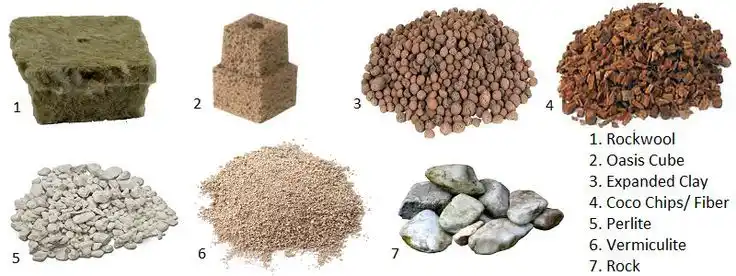
Hydroton and rockwool are two options among several hydroponic substrates. For a broader comparison, use the material and irrigation guides below.