
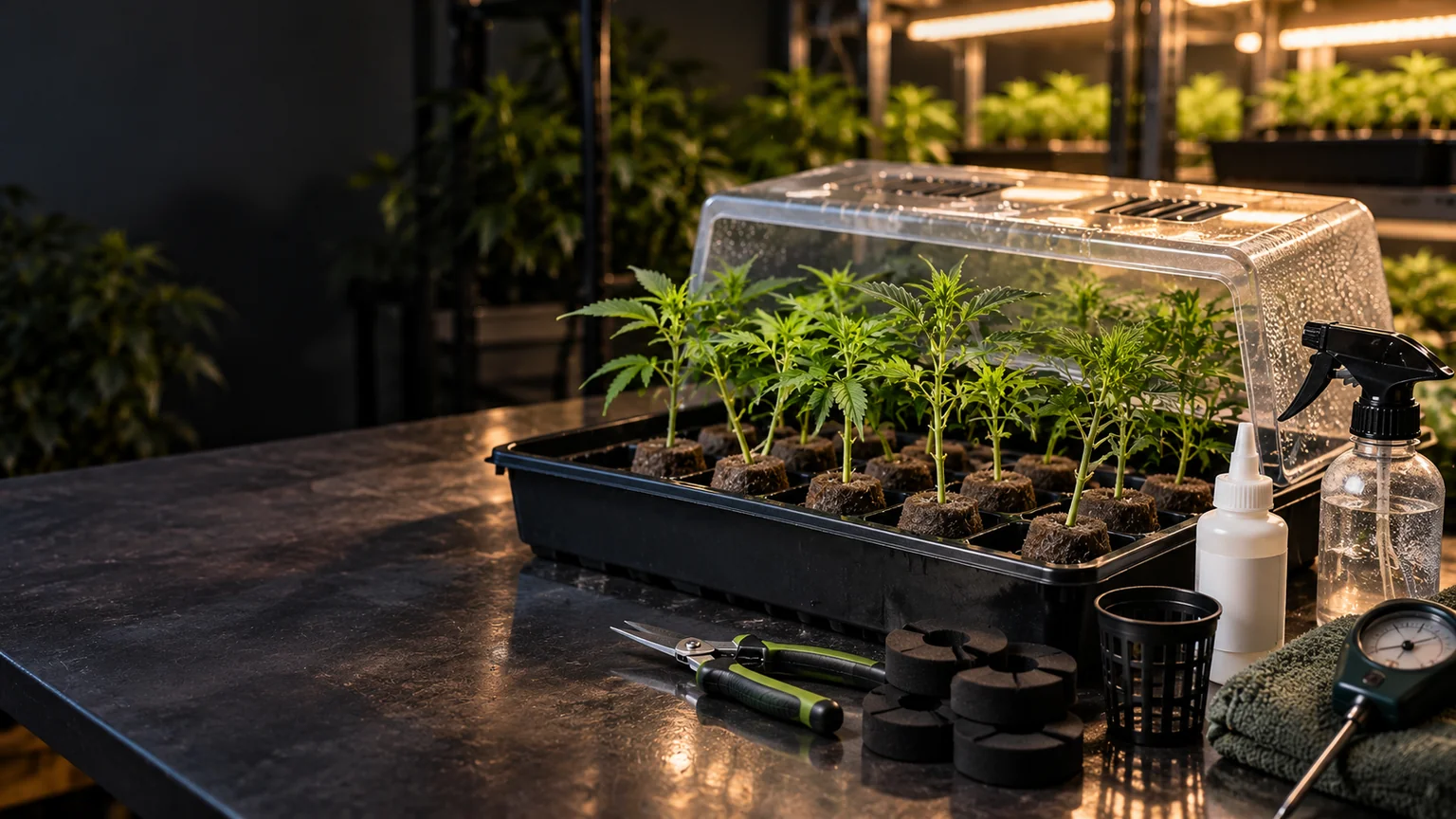
You do not need a cabinet full of supplements to root cuttings. Start with clean tools, a suitable rooting medium, a way to limit moisture loss and enough light to keep leaves functioning. Add specialized equipment only when the scale of your setup requires it.
Build the simplest complete cloning kit
Healthy, non-flowering cuttings taken from a vigorous mother plant are the starting point. The rest of the kit should help preserve moisture, prevent contamination and give new roots oxygen.
Clean cutting tool
A sharp blade or pruner and an appropriate disinfecting procedure. Prepare before taking a cutting; do not move dirty tools between plants.
Rooting plugs and tray
Choose an airy, moisture-retaining medium that fits its cells and drains appropriately. Match plug diameter to the tray and future transplant container.
Humidity management
A clean dome or similarly controlled environment can reduce early water loss. Vent and inspect it instead of keeping foliage permanently wet.
Gentle light and labels
Provide suitable indirect or low-intensity light, plant labels and a record of the cutting date. Excess heat and intense light can stress unrooted foliage.
Buy only for a specific limitation: rooting hormone may help with some plants, a thermostatically controlled heat mat may help a cold root zone, and an aeroponic cloner may make more sense for repeated batches. None guarantees successful rooting.
Rooting tray or aeroponic clone machine?
Both approaches require a suitable source plant, sanitation, modest light and inspection. Choose the method you can maintain reliably; a pump does not replace basic propagation care.
Plug tray + humidity dome
Cuttings sit in moisture-retaining plugs or other rooting media with a removable cover.
- What you buy: tray, matching plugs, cover and labels.
- What you maintain: moisture without saturation, clean cells and dome ventilation.
- Best fit: small batches or growers who want few moving parts.
Aeroponic cloner
Cuttings rest in collars above a reservoir; a pump delivers water to exposed stems and developing roots.
- What you buy: reservoir, lid, collars, pump, plumbing and sprayers.
- What you maintain: nozzle flow, pump intake, reservoir hygiene and temperature.
- Best fit: repeated batches where accessible replacement parts justify the cost.
Water reaches the cutting in different ways
What rooting gels and powders actually do
Hormex, Olivia's, Clonex and Rootech appear in this guide because they were among the products used or discussed in the original grow. Brand names alone do not prove a faster root time or prevent transplant shock. Compare the exact product label, active ingredients, application instructions and whether your cutting method calls for a hormone at all.
Rooting hormone
Some products contain auxins such as IBA that can encourage root initiation. More is not necessarily better; never assume that dipping directly into a shared jar is hygienic.
Vitamin or nutrient solutions
Vitamin B1 is not a substitute for healthy roots. A blanket claim that a supplement prevents transplant shock is unsupported, and old label dilution ratios may not match current formulations.
Use the exact product
If using a treatment, follow the product's current directions and local requirements. Pour a working amount into a clean separate container to reduce contamination.
For the full cutting and rooting procedure, follow the cloning guide; this page covers the equipment decisions.
Choose compatible parts, not brand promises
Collars and baskets
Check the cutout diameter in the lid, collar size, stem fit and material condition. A net pot is not a universal requirement for every cloner design.
Sprayer heads and tubing
Confirm actual thread specification, tubing diameter and spray coverage before ordering replacements. A fitting described as 10/24 on one historical build is not a standard for all manifolds.
Submersible pump
Match the pump curve to installed head, line losses and required spray performance. Accessible intakes and spare sprayers matter more than maximum box-rated flow alone.
Air stones and aeration
An air stone may serve a particular reservoir design, but it is not automatically the most important part of a spray cloner. Root oxygen depends on delivered water, air exposure, temperature and the system's layout.
For complete machines, compare reservoir access, replacement parts and fault recovery in the Clone Machine Guide. For a hands-on build, see the DIY Clone Machine article and original video.
Five checks worth doing before taking cuttings
- Fit every component. Check plug/tray size, collar openings or lid spacing with an empty system.
- Clean and label. Disinfect reusable parts and tools; label cultivars and dates before handling stems.
- Verify water behavior. Wet plugs and check drainage, or test pump delivery and every sprayer with clean water.
- Test the environment. Check light distance, dome air exchange and root-zone temperature; use a thermostat if heating.
- Plan inspection and replacement. Have a way to see roots, clear a clogged nozzle, and replace worn collars or contaminated plugs.
More feeding does not compensate for stagnant water or diseased stock. See Water and Nutrients for Clones for water-quality and rooting-environment care.
Parts from the original cloning setup
The original grow notes favored Hormex and described using replaceable spray heads in custom clone machines. Those are firsthand equipment preferences, not comparative trials. When purchasing modern replacements, verify current compatibility and instructions.

Previously referenced instructions:
cloning your marijuana mother plant aeroponic clone system build your own Custom Clone MachinePropagation references
Penn State Extension: Propagating Houseplants explains healthy source cuttings, humid air, clean tools and rooting media. Iowa State Extension: Rooting Media and Cuttings explains media aeration, humidity and how to avoid contaminating rooting hormone.