
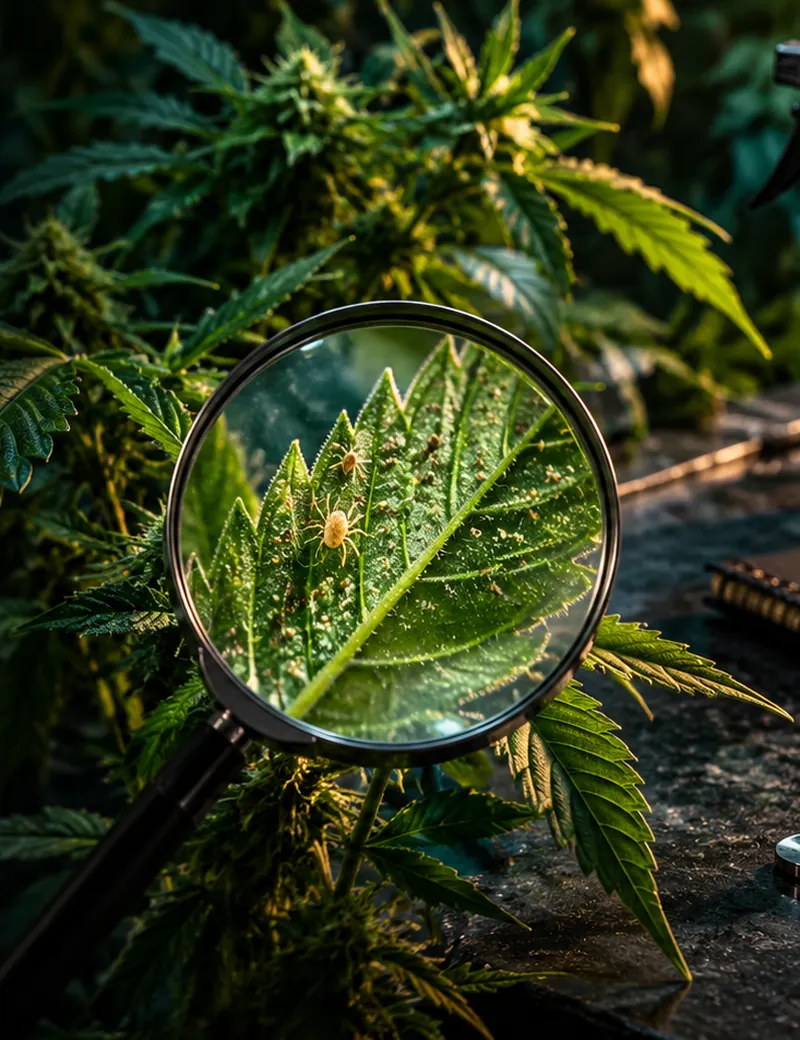
Plant care / pest management
Identify the problem. Then choose the lowest-risk response.
Spider mites, aphids, fungus gnats and powdery mildew are different problems. A product that works on one may not address another—and a pesticide permitted for an ornamental plant is not automatically permitted on cannabis.
First response
Three steps before reaching for a spray
- Inspect the plant
Check both leaf surfaces with a hand lens and record visible pests, eggs, webbing or mildew. Discoloration alone is not a diagnosis.
- Limit spread
Separate affected plants where feasible, check nearby plants, remove heavily infested debris and clean tools and benches. Keep the growing area free of plant waste.
- Choose and reassess
Consider suitable nonchemical or biological controls first. If a pesticide is necessary, verify that exact product and application method are permitted for your crop, then monitor whether the pest population changes.
Treatment reference
What common product categories can—and cannot—tell you
These are ingredient and product families, not a list of approved cannabis treatments. The permitted crop and use depend on the particular label and location.
Insecticidal soap
Horticultural and neem oils
Miticides, pyrethrins and synthetic pyrethroids
Copper, sulfur, bicarbonates and Bordeaux products
Boric acid and baits
Nicotine sprays and room foggers

This pictured pesticide container is a label-reading example, not a recommendation to use that product on cannabis. Check the exact label, permitted crop and local restrictions.
Never use bleach as a spray on cannabis plants.
Bleach is a surface-cleaning and disinfection chemical, not a crop treatment. Do not spray plants with it or mix it with other cleaners, acids or ammonia. For hard surfaces, follow the product's disinfection instructions, ventilation and personal-protection precautions. Keep cleaning chemicals away from plants, nutrient solutions and harvest materials.
Before any chemical application
Six checks on the actual container
- Exact trade name, active ingredients and EPA registration number
- Permitted crop, application site and local cannabis requirements
- Target pest and permitted application method
- Mixing directions, protective equipment and ventilation
- Repeat interval and any crop-stage or harvest limitations
- Directions for residues, disposal, storage and reentry
State rules can be more restrictive than a general gardening article. Colorado, for example, has separate pesticide criteria for retail marijuana. A product described as “organic,” “natural,” “minimum risk” or “safe on edible plants” is not automatically authorized for cannabis flowers or inhaled products.