
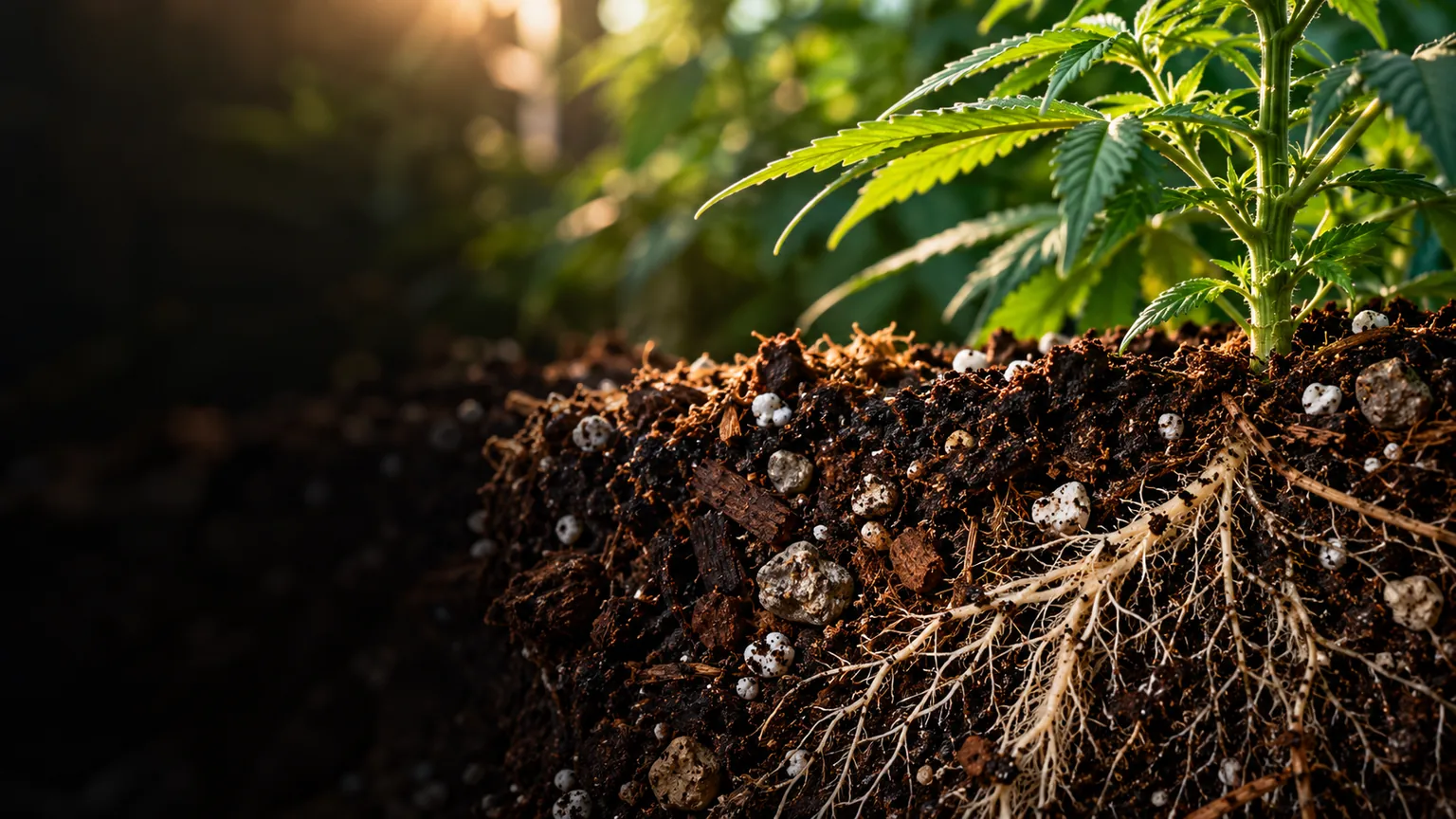
ROOT ZONE / SOIL STRUCTURE
Healthy Roots Need Air, Water, and Room to Grow
Good container soil is more than dirt. A well-structured growing medium holds moisture and nutrients while leaving air-filled pores for roots. Texture, particle size, organic matter, irrigation and drainage all affect that balance.
01 / THE ROOT ENVIRONMENT
Think in Pores, Not Just Ingredients
Sand, silt, clay and organic components behave differently. Their proportions influence drainage, oxygen and how easily water moves through a root zone. A prepared potting mix is not identical to native mineral soil: many use peat, coco coir, bark and perlite instead.
When pores remain waterlogged, roots have less access to oxygen. When a container dries too rapidly, water availability becomes limiting. Choose a medium suited to your container and watering habits.
Dense, Compacted Soil
Small, tightly packed pores can restrict drainage, gas exchange and root penetration. Adding a little sand to clay is not a universal fix.
Well-Structured Container Mix
A suitable blend supports both moisture retention and drainage. Container depth, size, compaction and irrigation still matter.
02 / CHOOSING A MEDIUM
A Practical Pre-Plant Check
- 01Check drainage.
Use containers with clear drainage pathways; water should not stay pooled around roots.
- 02Feel the structure.
A damp medium should maintain some texture instead of becoming a hard, airless mass.
- 03Read the fertility label.
Pre-fertilized media may contain nutrients already. Avoid adding fertilizer blindly.
- 04Match your irrigation.
More frequent watering may suit a different medium than occasional hand-watering.
For other root-zone options, compare soilless growing media and hydroponic systems.
03 / CHEMISTRY AND TEMPERATURE
pH and Temperature Need Context
Test the Root Zone
The pH of your irrigation water is not automatically the pH of the soil. Use a medium-appropriate test and consider water alkalinity. A single perfect 6.2 target does not apply to every substrate.
Understand root-zone pH →Avoid Temperature Extremes
Cold conditions can slow root function; excessive heat and wetness can cause other problems. Seed-starting heat mats may be useful when controlled, but keeping mature soil above 65°F at all times is not a general requirement.
Seedling care →Follow manufacturer-rated propagation-mat and electrical safety instructions. Keep water away from sockets, timers, and cables.
Reference Photographs

Research and Practical References
University of Minnesota Extension: Soil Health · Penn State Extension: Growing Media · Oklahoma State Extension: pH and EC
CONTINUE LEARNING