
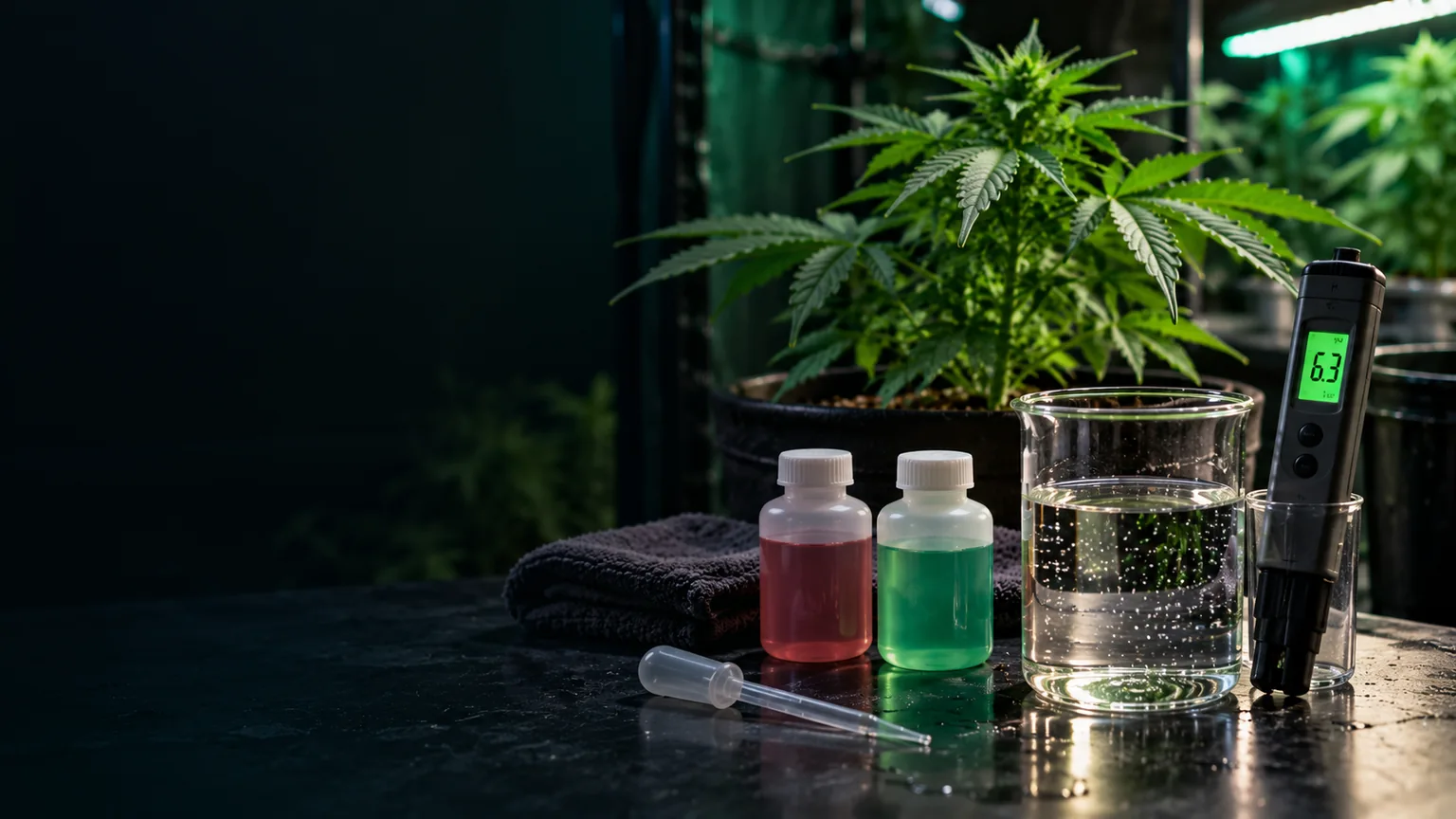
THE ESSENTIAL IDEA
pH changes availability; it is not a nutrient concentration.
pH describes how acidic or basic a solution is. It influences nutrient solubility, root uptake and microbiology, but it does not tell you whether a solution contains enough nitrogen, calcium or any other nutrient. Read it with growing-medium context and electrical conductivity.
01 / THE LOGARITHMIC SCALE
One unit. Tenfold.
A small move on the pH scale can mean a large change in hydrogen-ion activity. Compare two readings to see the relationship.
Hydrogen-ion activity
—Factors for fractional pH gaps are rounded to 3 significant figures. “e+N” means ×10 to the power N. This comparison does not tell you how much pH Up or pH Down to use.
HOW TO READ IT
The gap is an exponent.
pH = −log₁₀ a(H⁺), where a(H⁺) is hydrogen-ion activity. Subtract the readings, take the absolute difference, then raise 10 to that power. The lower pH has the higher activity.
Activity is a chemical measure, not a fertilizer quantity. Equal pH does not mean two waters have identical chemistry. Definition: IUPAC Gold Book.
| A / B | Gap | Factor |
|---|---|---|
| 6 / 7 | 1 | 10× |
| 5 / 7 | 2 | 100× |
| 6.5 / 7 | 0.5 | ≈ 3.16× |
A comparison, not a prescription. These readings cannot establish buffering capacity, diagnose a plant, calculate an adjustment dose or predict the pH of a mixture.
02 / ROOT-ZONE CONTEXT
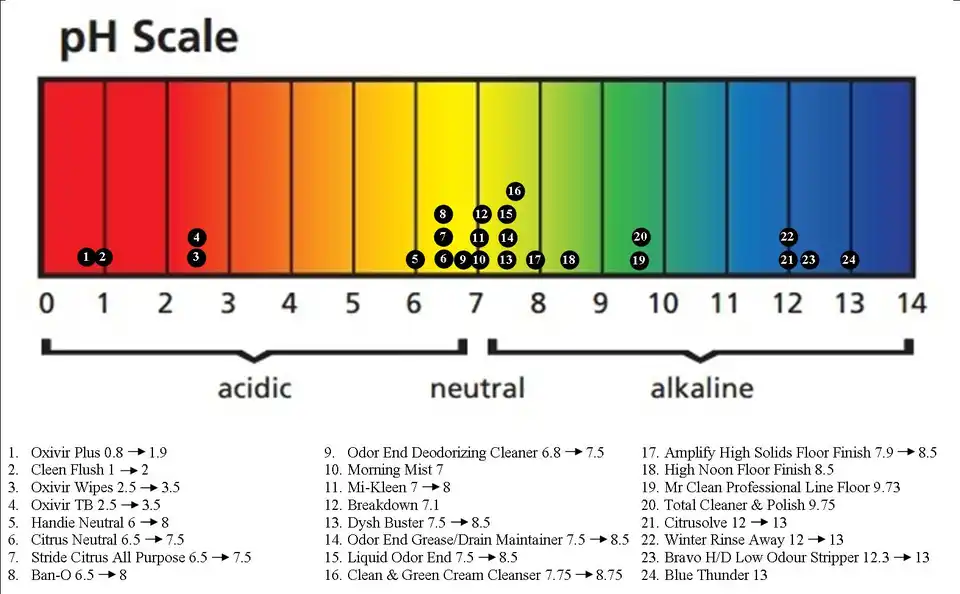
Acidic, neutral and alkaline: one scale, different root environments.
These broad reference ranges are starting points for common container growing systems, not cannabis-specific guarantees. Soil and soilless substrates have different buffering behavior. The pH of the irrigation water alone does not prove the pH around roots.
Common starting area: roughly pH 6–7
Test the actual root-zone substrate. Organic matter, liming materials and water alkalinity influence buffering.
Common starting area: roughly pH 5.5–6.5
Use the crop, medium and fertilizer supplier's measurement instructions. A target for solution pH is not automatically a target for extracted media pH.
General horticultural references, not a universal ideal of 6.2: MU Extension and Purdue Extension.
03 / PRACTICAL MEASUREMENT
Take a reading you can trust.
Calibrate
Use fresh pH reference buffers appropriate to the meter, commonly pH 4 and 7. Follow its instructions and storage requirements.
Sample consistently
Measure a mixed nutrient solution after additions settle. For media, use an established substrate-extract or pour-through procedure, not an arbitrary runoff reading.
Log the context
Record date, water source, medium, solution temperature, pH, EC, and any changes. Look for patterns rather than chasing a single decimal.
Change one variable
Use labeled commercial adjustment products as instructed, stir fully, remeasure, and avoid overshooting. Wear suitable protection and never mix concentrates.
04 / DIAGNOSIS
When pH looks wrong, do not start by guessing nutrients.
Check source-water alkalinity, fertilizer composition and reservoir changes. Recalibrate before correcting.
pH alone cannot diagnose the symptom. Inspect roots, irrigation, pests and overall nutrition before treating a deficiency.
Clean and condition the probe, check buffers and storage solution, and wait for stabilization.
Never handle concentrated acids or bases casually. Follow product safety labels, use eye and hand protection, and never combine concentrated pH adjusters with fertilizer concentrates.
05 / QUESTIONS WORTH ASKING
What the number leaves out.
Can pH tell me how much adjuster to add?
No. pH is a reading of the present acid–base condition. Alkalinity describes water’s capacity to neutralize acid, so two samples with the same pH can respond differently to an addition. Follow product instructions, measure consistently and investigate persistent drift. USGS explains alkalinity.
Why does one unit mean tenfold?
The scale is logarithmic. A difference of 1 gives 10¹ = 10; a difference of 2 gives 10² = 100. For example, pH 5 has 100 times the hydrogen-ion activity of pH 7. USGS explains the pH scale.
Can I average two readings to predict a mixture?
No. pH alone does not describe the quantities of acid, base and buffering substances in each sample. Mixing depends on their chemistry and proportions. Measure the mixed solution after it has stabilized using a suitable method.
Is pH 7 always neutral?
Pure water is neutral at pH 7.00 at 25°C. Its neutral pH changes with temperature. The 0–14 range shown here is a familiar illustration, not a limit on every solution. USGS pH measurement reference.
References
Oklahoma State University · University of Missouri Extension · Purdue University Extension
CONTINUE LEARNING