
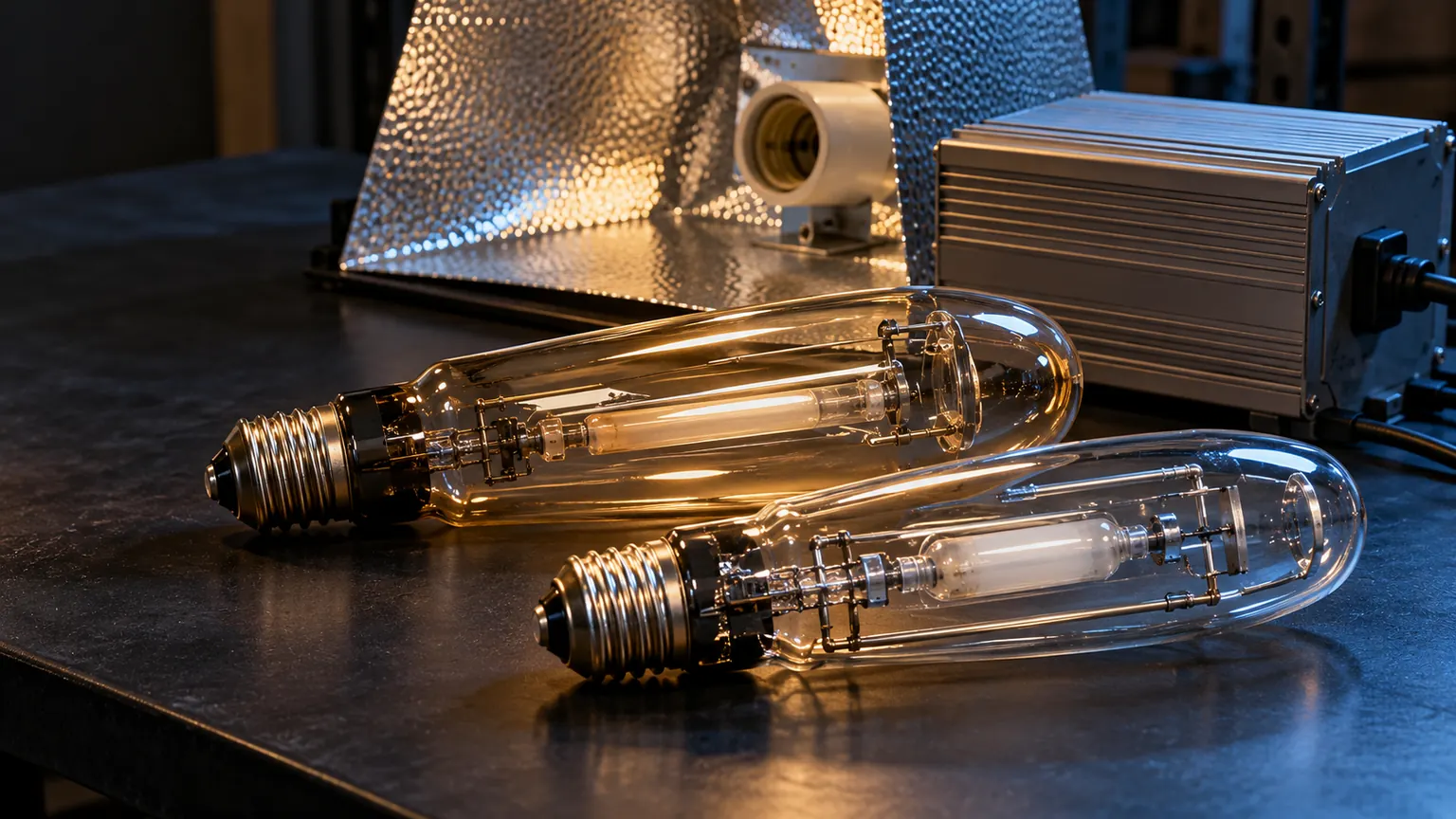
Replace the lamp, not the safety margin.
High-pressure sodium (HPS) and metal-halide (MH) lamps may look alike, but they are not universally interchangeable. The correct replacement is determined by the ballast's approved lamp specification, the lamp's rating and ignition requirements, and the fixture's socket and temperature limits. Match all of them before placing an order.
The six checks that decide compatibility.
A shared screw base or matching watt number does not establish a compatible lamp. Find the manufacturer's specification sheet and read the actual label on your ballast or fixture. If the model or rating is illegible, stop rather than testing an unknown combination.
Lamp technology
HPS, quartz MH and ceramic MH (CMH/CDM) can require different ballasts or ignitors.
Approved lamp watts
Use only the lamp wattage and ballast operating modes specifically approved by the manufacturer.
Electrical/ANSI designation
For applicable North American systems, compare the actual lamp and ballast ANSI codes, not just brand names.
Socket and lamp shape
Confirm the base, single-ended versus double-ended format, clearance and required shielding.
Starting and dimming support
Check pulse-start/probe-start, ignitor and dimming requirements; never assume a “universal” ballast accepts everything.
Fixture and installation
Respect the complete fixture's voltage, enclosure, lens, grounding and temperature specifications.
Any missing specification is a reason to consult the fixture manufacturer or a qualified lighting/electrical professional—not a reason to experiment with a live lamp.
HPS and metal halide serve different purposes.
Typically warmer-spectrum output
Commonly used in older flowering rooms and supplemental horticultural installations. Light quality, efficiency and degradation depend on the specific lamp and ballast.
Replacement priorityMatch the ballast's HPS lamp rating, ANSI/electrical code where applicable, and the fixture's single- or double-ended design.
Read the HPS guide →Often cooler-spectrum output
Traditional quartz MH lamps were used for vegetative lighting. CMH is a different family with model-specific control-gear requirements.
Replacement priorityDistinguish quartz MH, pulse-start MH and CMH; verify lamp start method and ballast compatibility.
Read the MH guide →| Format | Check before buying | Common mistake |
|---|---|---|
| Single-ended HID | Base, wattage, electrical code, fixture rating | Assuming every mogul-base lamp works |
| Double-ended HPS | Exact DE socket, ballast and manufacturer pairing | Substituting a single-ended lamp |
| CMH / CDM | Dedicated or explicitly approved ballast, ignition and holder | Treating CMH as a standard MH replacement |
When the light gets weaker—or refuses to start.
Some HID lamps cycle off and on near end of life; overheating, ballast problems or unsuitable supply conditions can produce similar symptoms. Shut down and diagnose before further use.
Could involve the lamp, socket, ignitor, ballast or supply. A known-good replacement is only meaningful after verifying that its exact specifications match.
Output depreciates with operating hours even if the lamp still ignites. Keep a service log and compare manufacturer-maintenance guidance or repeatable canopy measurements instead of using one universal replacement interval.
Disconnect power. Do not continue operating a visibly damaged lamp or touch fragments without appropriate precautions. HID lamps may contain mercury; follow local lamp-recycling guidance.
A ballast can contain hazardous stored electrical energy after unplugging. This is a lamp-selection guide, not a ballast-repair or electrical wiring tutorial. Do not open or repair electrical gear without qualified training.
Five steps for a safe, clean lamp change.
- Power down and isolate. Turn the system off, disconnect it from supply as required by the fixture instructions, and prevent accidental restart.
- Wait until completely cool. HID lamps and reflectors can remain extremely hot. Follow the manufacturer's cooling and re-strike guidance.
- Verify the replacement. Recheck lamp identification, required shielding, base, wattage, ballast rating and fixture instructions before opening the package.
- Handle and fit as specified. Use the manufacturer's recommended handling method; keep glass clean, avoid touching the arc tube, and never force a threaded or double-ended holder.
- Inspect, restart and log. Confirm covers/guards are in place, restore power according to instructions, observe operation from a safe distance, and record the lamp model and replacement date.
Fluorescent tubes are not HID replacements.
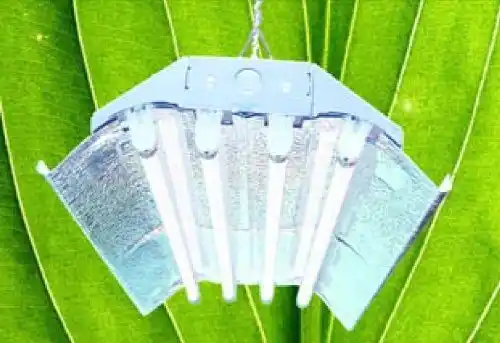
The photo shows fluorescent-tube lighting hardware. Fluorescent tubes, compact fluorescent bulbs, LED fixtures and HID lamps have different electrical and socket requirements; they are not drop-in replacements for one another. Use the exact lamp and ballast model specifications when sourcing a part.
For an alternative to an aging HID system, compare LED grow-light fixtures and running electricity costs before buying replacement hardware.
Compatibility and safety references
Signify / Advance ballast reference · Keystone HPS ANSI equipment examples · P.L. Light lamp-and-ballast replacement parts. These resources illustrate how detailed model matching works; they do not certify a reader's particular fixture.