
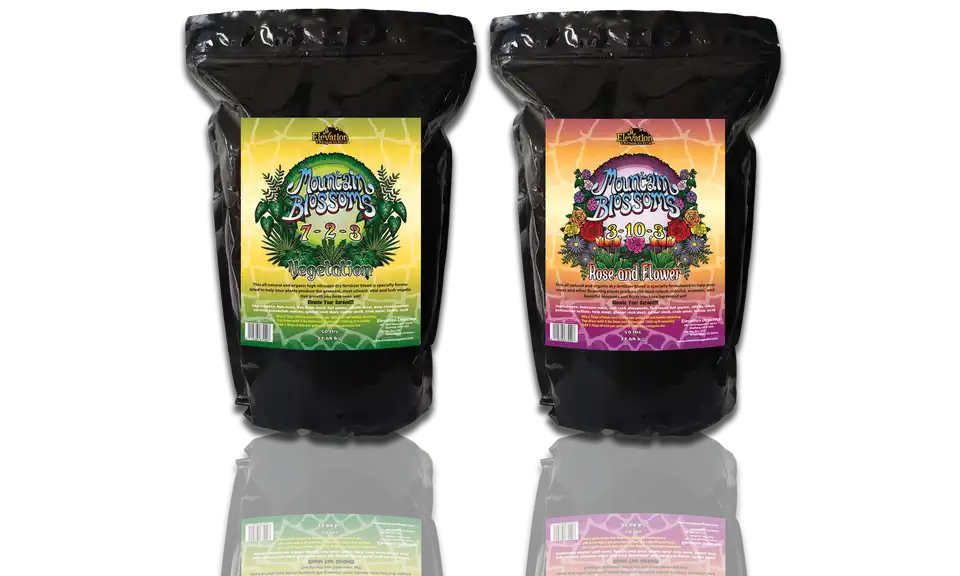
SOLUBLE POWDERS / GRANULAR AMENDMENTS
Not all dry fertilizers work the same way.
Dry fertilizer may be a fully water-soluble mineral powder formulated for fertigation, or a granular amendment designed to be incorporated into soil. Those are different applications. Check the product's solubility, guaranteed analysis and directions before adding anything to a reservoir.
Intended to dissolve to a specified working concentration when used according to the label.
May release nutrients over time; not automatically suitable for pumps or hydroponic tanks.
Weigh carefully and check the mixed solution when directed.
01 / READ THE PACKAGE
Soluble powders aren't the same as slow-release granules
Dry mineral nutrient blends
Designed to dissolve in water when used at labeled ratios. Multi-part salt programs may separate calcium from phosphate and sulfate components until dilution to avoid precipitation.
Granular and organic amendments
Designed for soil incorporation or top-dressing. Nutrient release and solubility depend on the specific material and conditions; never assume an amendment belongs in an injector or reservoir.
The same N-P-K numbers do not guarantee the same solubility, dose or plant response. Use the NPK label guide for reading fertilizer percentages.
02 / WATER-SOLUBLE POWDERS ONLY
Measure the mass. Dissolve each compatible component.
Confirm it is intended for dissolution and the correct growing medium.
Use a scale with suitable resolution; a scoop's volume is not a reliable substitute for grams.
Add salts to water at the recommended concentration, stirring thoroughly. Keep incompatible stock concentrates separate.
Look for undissolved solids and check EC and pH where indicated, considering the baseline water.
Calcium, phosphates and sulfates can form insoluble deposits when mixed at high concentrations. University extension guidance describes using separate A and B solutions where the formulation requires them. Never improvise a recipe from ingredient names alone.
See the University of Florida greenhouse fertilizer handbook ↗03 / CHOOSING A FORMAT
Dry powder or liquid concentrate?
| Consideration | Dry, soluble powder | Liquid concentrate |
|---|---|---|
| Measure | Usually mass, such as grams | Usually volume, such as mL |
| Preparation | Weigh and dissolve fully | Measure and dilute correctly |
| Storage | Keep dry and tightly sealed per label | Follow container, temperature and label storage directions |
| Compatibility | Separate incompatible concentrated stocks | Keep incompatible liquid concentrates apart |
| Cost comparison | Compare price at working strength | Compare price at working strength |
A powder is not inherently more potent or better for yield than a liquid. The relevant question is whether the final nutrient solution and growing system match the crop's needs.
See Liquid Nutrients for the bottle-measuring workflow, or pH Levels for understanding nutrient solution acidity.