
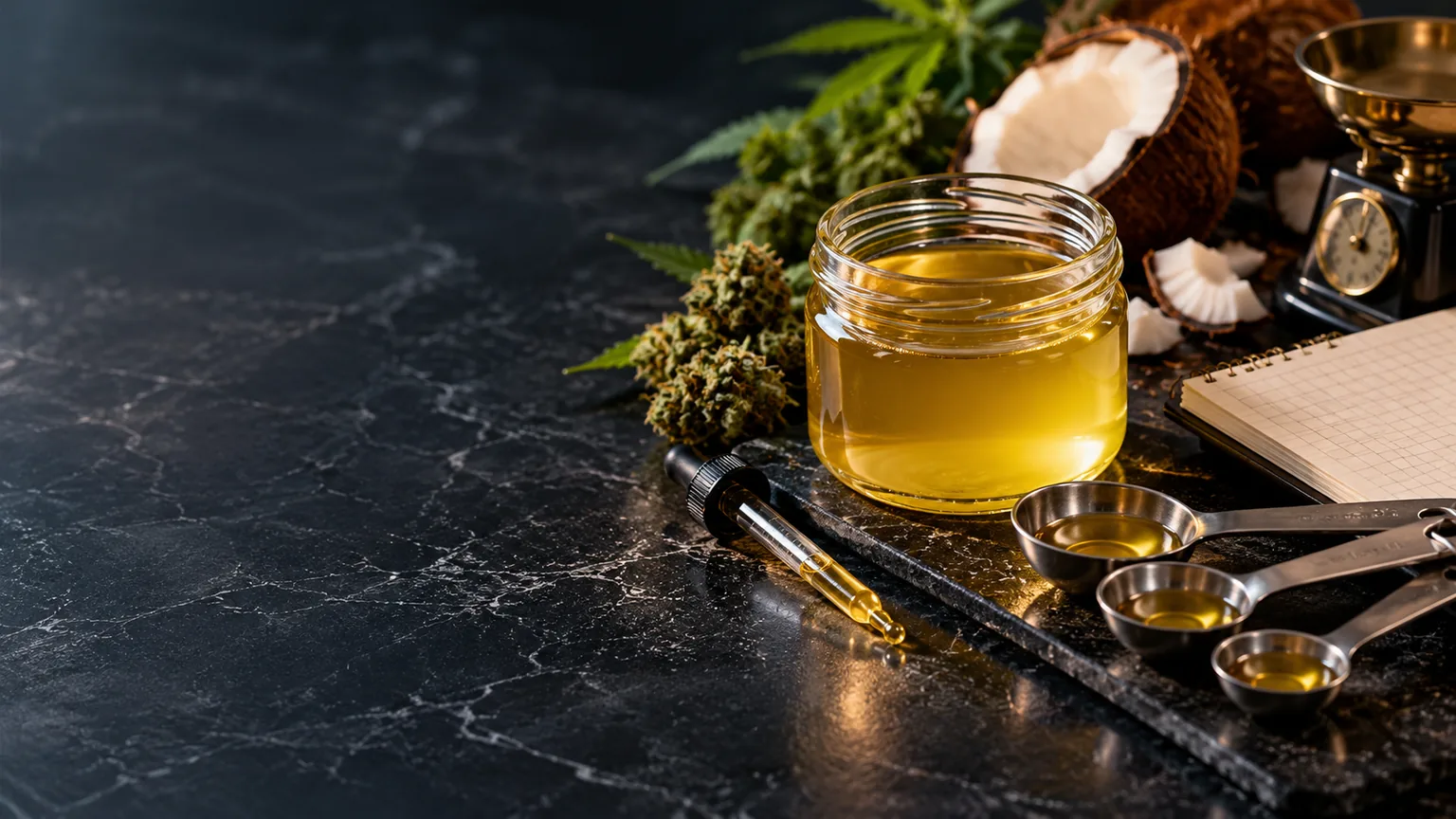
COCONUT OIL / POTENCY WORKBENCH
Know which numbers you have. See exactly what the math can tell you.
Open calculatorCompare a hypothetical flower-to-oil scenario or calculate a concentration from a tested finished-oil result. The first is an estimate; only the second uses a measured THC input for the oil itself.
01 / THE CALCULATOR
Calculate THC concentration
Choose the kind of information you actually have.
02 / THE RESULT
A transparent estimate
Not calculatedResults are blank until the required inputs are supplied. A flower-based model cannot test finished oil.
- Per teaspoon
- —
- Per mL
- —
- Whole batch
- —
- Per US cup
- —
Concentration is not a serving recommendation. Oil may be unevenly mixed; a numerical estimate cannot establish a safe portion.
Potential is not measured potency. Flower labels describe the starting material. Processing, filtration, mixing and final volume affect the oil. The dosage and measurement guide explains the difference in depth.
03 / UNDERSTAND THE NUMBERS
What the calculator is doing
Two paths, one question: how many milligrams would be in a measured amount of finished oil?
Start with theoretical THC
Flower grams × 1,000 × (total potential THC % ÷ 100) gives a starting-material potential. Multiplying by your explicitly assumed retained fraction produces a scenario, not a verified extraction yield.
Potential mg × assumed retention ÷ finished tablespoons
Start with the oil's lab result
If a report provides finished-oil THC in mg/mL, multiply by the volume of one US tablespoon (approximately 14.79 mL). Batch total also depends on your measured recovered volume.
Tested mg/mL × 14.79 = mg / tbsp
WORKED SCENARIO / NOT A LAB RESULT
14 g of flower at 20% potential THC
That is 2,800 mg potential starting THC. If you choose an illustrative 80% retention, the mathematical scenario is 2,240 mg remaining. With 16 tablespoons of finished oil, it would calculate to 140 mg per tablespoon—but that figure does not represent a measured batch or a suggested serving.
04 / BEFORE YOU USE IT
Three things worth checking
Read the potency label
If a lab report lists THCA and delta-9 THC separately, total potential THC is calculated as (THCA × 0.877) + delta-9 THC, not their simple sum. The general THC potency tool has a separate lab-label mode.
Measure the finished amount
Input oil volume is not necessarily recovered volume. Straining losses and evaporation change the concentration calculation. Do not substitute the amount poured into the cooker for the final amount without measuring.
Keep edible products secure
Swallowed cannabis can take 30 minutes to 2 hours to start producing effects. Store clearly labeled infused oil securely away from children and pets, and do not drive impaired. CDC edible safety guidance.