
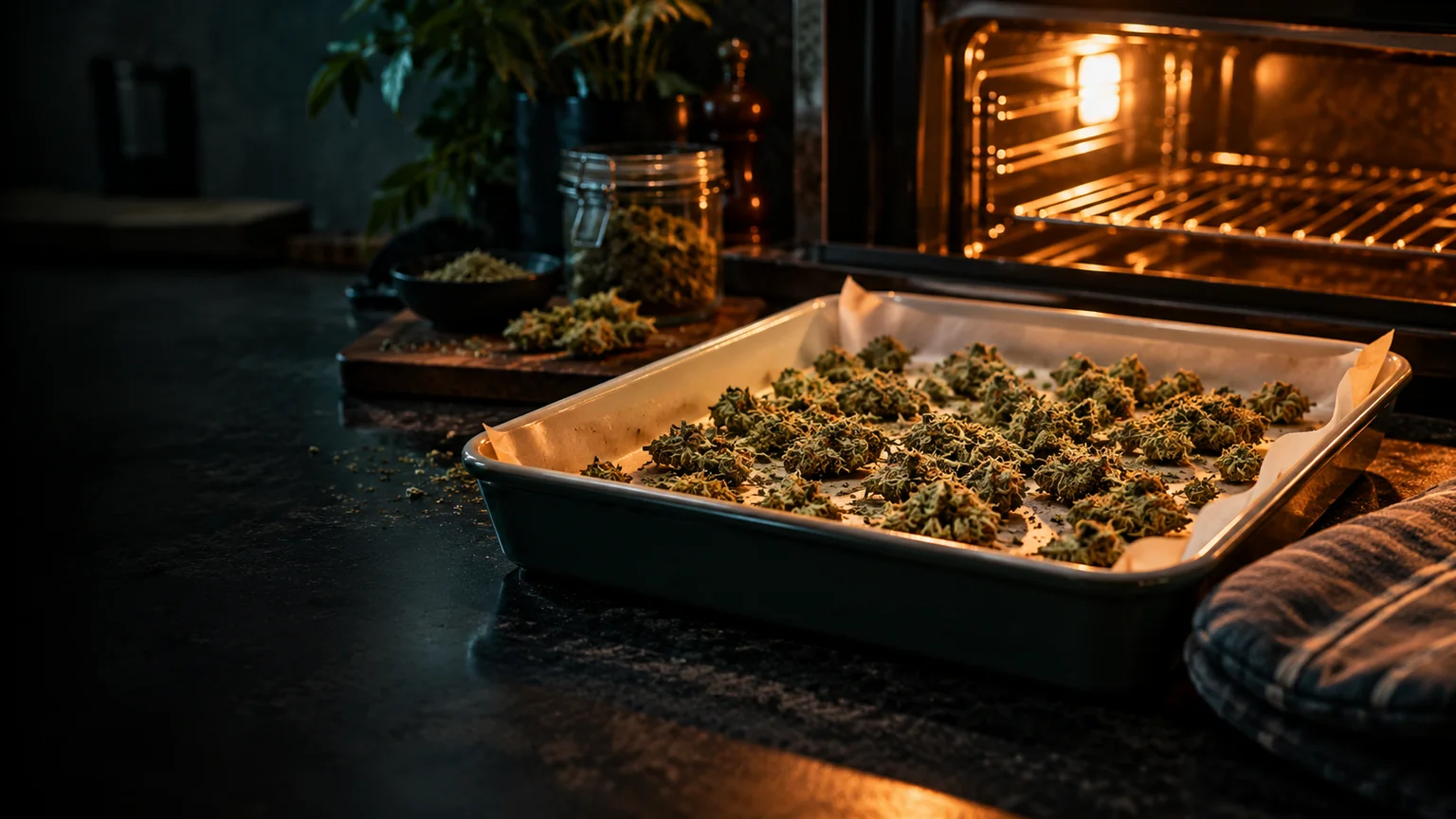
Decarboxylation uses heat to convert some THCA naturally present in cannabis flower into THC. Before making infused food, the heated flower can be combined with coconut oil, butter, or another ingredient. This step does not establish the THC content of a finished serving.
01 / THE CHEMISTRY
Heat changes the molecule. It does not reveal the dose.
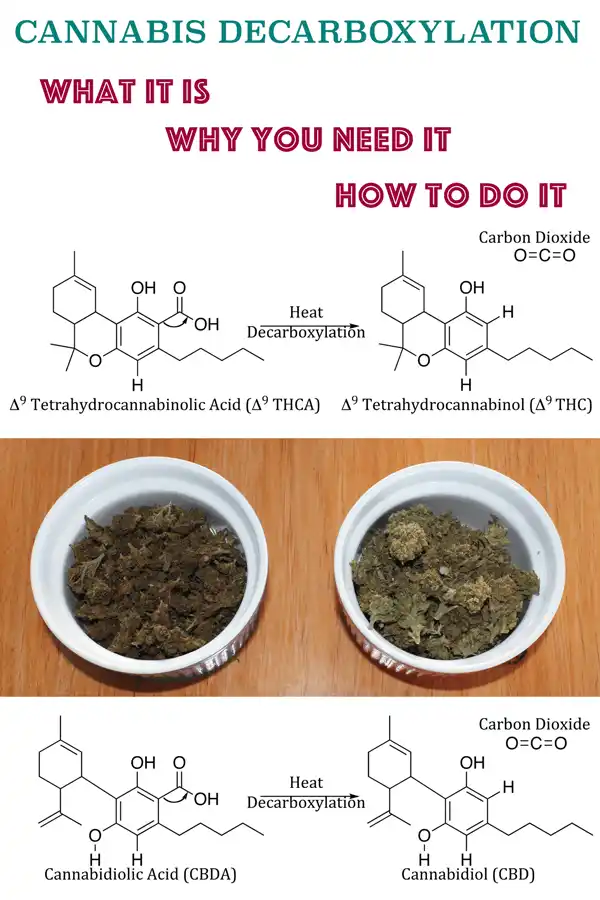
Fresh and dried cannabis flower often contains more THCA than THC. With enough heat over time, THCA loses a carboxyl group as carbon dioxide and becomes THC. The same general reaction turns CBDA into CBD. Heating also exposes cannabinoids and terpenes to conditions that can cause losses.
The formula describes what can happen chemically. It does not say how much THCA converted in any particular oven or whether the final edible is evenly mixed.
View additional chemistry and oven illustrations

02 / TEMPERATURE IS ONLY ONE VARIABLE
Why a kitchen oven cannot guarantee an exact result.
Actual temperature
The setpoint on an oven dial may not equal the temperature around the flower. Oven cycling and tray placement both matter.
Time at temperature
Conversion speeds up as temperatures rise, but extended heating can reduce recovery of the neutral cannabinoids you want to retain.
Starting flower
Moisture, particle size, batch depth, cannabinoid profile and oxygen exposure can change the outcome.
A widely used home-oven starting point for dried flower—not a universal optimum, a laboratory-tested endpoint or a guarantee of fully converted THC. Follow the single oven method below and monitor for scorching.
Controlled studies measured different time–temperature combinations in specific extracts or plant samples; those findings do not directly calibrate every home oven. Wang et al., 2016 · ACS comparative kinetics, 2020
Further references: controlled-process optimization and CDC edible poisoning prevention.
03 / ONE OVEN METHOD
Prepare consistently; use the recipe card for the steps.
Use clean, oven-safe equipment. Break dry flower into loose pieces rather than powder and spread it in a shallow, even layer. An oven thermometer can help reveal temperature drift. Stop heating if there is smoke or scorching, and let the material cool before adding it to an infusion.
The oven method and ingredient list directly below are the page's single set of instructions.
04 / UNDERSTAND WHAT THE NUMBERS MEAN
Potential THC is not THC per serving.
The factor comes from molecular mass: a THCA molecule loses CO₂ during conversion. For example, 100 mg of THCA has a theoretical maximum of roughly 87.7 mg THC before processing losses. This is not a measured yield and cannot predict the potency or uniformity of homemade butter or food.
For an explicitly uncertain planning estimate, use the THC potency calculator. A laboratory analysis is needed to verify actual cannabinoid concentrations.
05 / COMMON QUESTIONS
What readers often misunderstand.
Does cannabis have to be heated for THC effects?
Cannabis contains varying amounts of THC already, and heat can convert additional THCA to THC. Smoking and vaporizing heat material differently from an oven; eating raw flower is not equivalent to using a reliably characterized THC product.
Is higher temperature always faster and better?
Higher heat can speed decarboxylation, but it also raises the risk of cannabinoid loss and scorching. There is no single ideal oven setting for all flower batches.
Does a golden-brown color prove full conversion?
No. Color and aroma are not validated cannabinoid tests. You cannot determine THCA-to-THC conversion or resulting dose by sight.
Does decarboxylating determine edible strength?
No. Starting concentrations, conversion, extraction efficiency, dilution, mixing and portion size all affect the final result. Homemade edibles can be unevenly distributed, and the outcome is not lab verified.
Cannabis Decarboxylation: Oven Method
Cannabis Decarboxylation done in your kitchen oven using just a few simple ingredients and clear oven steps for preparing cannabis flower before infusion, allowing the cannabis to then be used in things like foods, topicals (lotions), cannabutter, cannabis oils, to name a few.
Ingredients
- as much ground cannabis as you plan on using for whatever it is you'll be making
- a cookie sheet or oven safe dish
- tin foil
Instructions
- place the ground cannabis flower onto the cookie sheet or dish
- cover with foil
- bake at approximately 240°F (116°C) for about 40 minutes while watching for scorching; stop heating if smoke appears
- remove from oven and let cool
- Allow the flower to cool before using it in butter, oil, or another preparation. Clearly label and securely store infused products away from children and pets.