
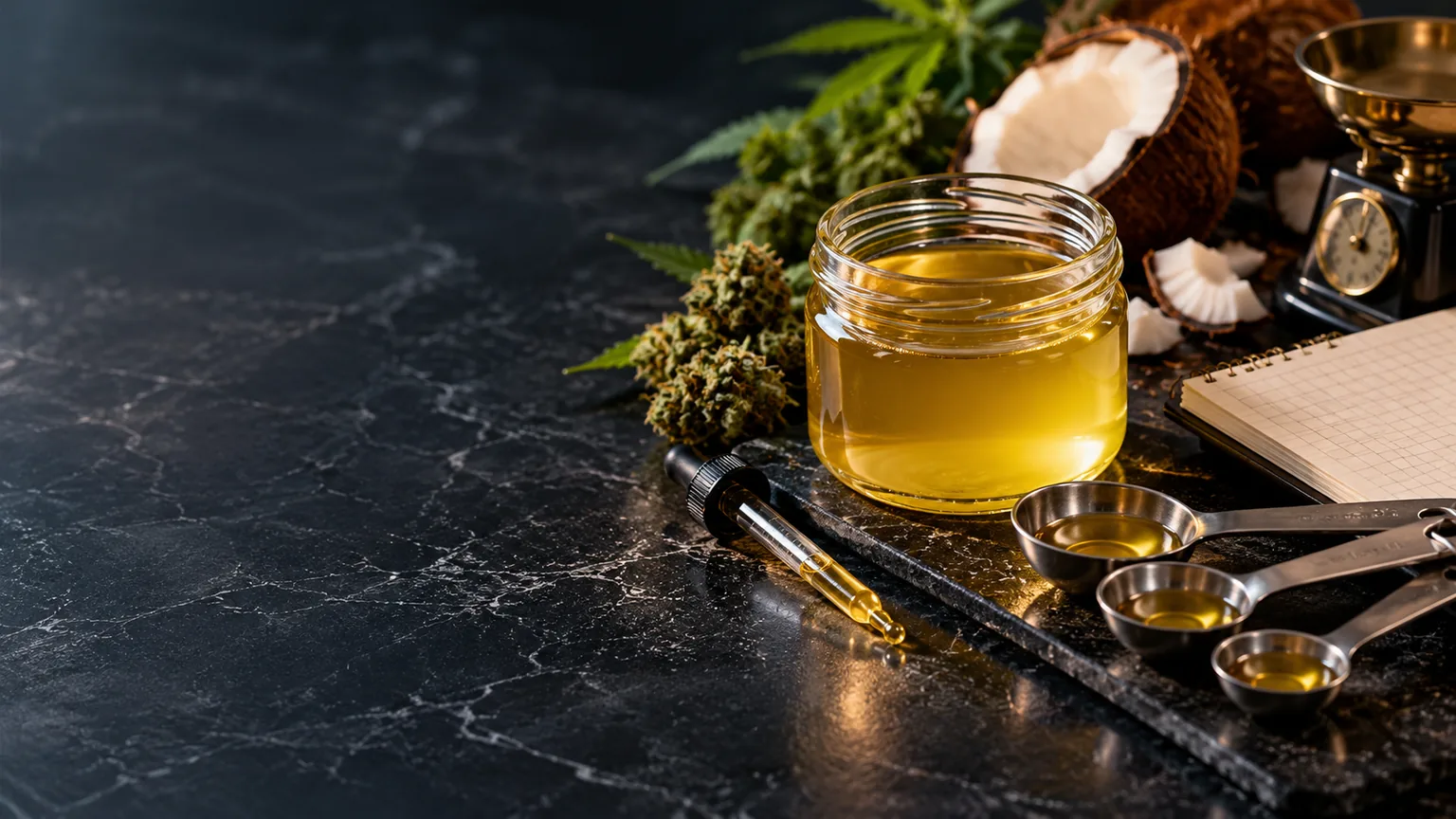
One of the most common questions after making cannabis coconut oil is: how strong is it? The answer depends on the amount of cannabis used, the THC percentage of the flower, and the amount of oil used during infusion. This guide will help you estimate potency and understand why finished-oil THC strength needs actual measurement.
Need a recipe first? Follow our complete Crockpot Cannabis Coconut Oil Recipe before estimating potency.
Want to examine the assumptions? Use our Cannabis Coconut Oil Potency Calculator .
First, know what the numbers actually measure.
Homemade infused oil does not come with a reliable THC-per-spoon number. Flower potency tells you about the starting material; it does not tell you how much THC transferred into the strained oil or how evenly that oil was mixed. Only appropriate testing of the finished oil can establish its actual THC concentration.
Potential THC
Flower weight multiplied by a total potential THC percentage estimates the amount in the starting material, before decarboxylation and infusion losses.
Unknown retention
Heat, cannabinoid conversion, extraction, material retained in the filter and mixing all change the result. A guessed percentage is not a laboratory result.
Measured concentration
A tested finished-oil result, paired with an actual measured final oil volume, is the basis for a defensible mg-per-tablespoon calculation.
What 14 grams at 20% can and cannot tell you
If 14 g of flower is labeled 20% total potential THC, the starting-material calculation is 14,000 mg × 0.20 = 2,800 mg potential THC before processing. That is not a measured yield, a finished-oil concentration or a recommended serving. If the label instead lists THCA and delta-9 THC separately, the potential-THC calculation also needs the THCA-to-THC conversion factor.
There is no reliable basis here for promising 2,200–2,500 mg extracted, or for assigning a fixed amount to a spoon. The small-batch crockpot cannabis coconut oil recipe also starts with a different proportion—one-quarter cup of oil and one-quarter cup of loose flower by volume, not 14 grams of tested flower.
THC per tablespoon = measured total THC in the batch ÷ measured finished tablespoons.
THC per teaspoon = THC per tablespoon ÷ 3. (1 US tablespoon = 3 US teaspoons.)
A worked example—not a potency prediction
Imagine a lab-tested finished batch containing 48 mg total THC with a measured final volume of 16 US tablespoons (1 cup). Its arithmetic is 48 ÷ 16 = 3 mg per tablespoon; 3 ÷ 3 = 1 mg per teaspoon. These are deliberately hypothetical inputs, not claims about homemade infusion efficiency, an expected recipe outcome or a safe dose.
Without a finished-oil lab result, enter only known values into the THC potency calculator to explore an assumption-based scenario, not to certify a batch. For THCA and delta-9 labels, choose the corresponding lab-input mode so conversion is applied only where appropriate. Decarboxylation changes cannabinoid form; it does not guarantee an extraction yield.
Why an edible “experience chart” cannot predict your response
The same labeled THC amount can affect different people differently. Previous experience, medications, alcohol, food intake and other factors matter. Do not use a beginner/moderate/strong chart to classify an unknown homemade oil or infer a universally safe serving. Edible effects can take 30 minutes to 2 hours to begin and may last longer than expected; taking more before effects develop increases poisoning risk.
Label and secure every batch
Write the contents, date and—only if tested—the measured strength on its container. Store securely, locked and out of the sight and reach of children and pets. Do not drive while impaired. If someone may have been poisoned, contact Poison Control at 1-800-222-1222; call emergency services for severe symptoms. CDC: cannabis and poisoning.
NEXT IN THE KITCHEN
Put the numbers in context
Start with the coconut oil method, see how heat changes cannabinoids, or explore another infused recipe. A calculator can model assumptions, but it cannot measure an untested batch.