

Two arthritis trials. Two different answers.
Dogs in one small trial appeared more comfortable on a particular CBD oil; another longer trial could not measure an improvement. Here is what each team actually tested, what changed, and what that can tell you about your dog.
Owners reported less pain and more activity
Twenty-two client-owned dogs with osteoarthritis were recruited; 16 finished. In a blinded crossover, dogs received a specific hemp extract oil and placebo for four weeks each. Owner-scored pain and activity improved during the CBD period; veterinarians also recorded lower pain scores. Veterinarian-scored lameness and weight-bearing did not significantly change.
No difference on the outcomes measured
Client-owned dogs with naturally occurring osteoarthritis completed six weeks on CBD and six on placebo in this double-blind crossover. Researchers found no differences on gait analysis, wearable activity counts, or the clinical questionnaires they used.
Why both results can be true
Owner ratings can capture changes in everyday life that a lab gait test misses. They can also fluctuate with expectations, activity, or other care. These trials were small and used different preparations and methods, so the difference cannot be pinned on one cause. A 2023 review rated the evidence for reduced osteoarthritis pain as very uncertain. See the review’s evidence assessment.
A more recent trial: A 2025 randomized study allocated 17 dogs to a particular CBD-and-THC extract or placebo. It did not find a statistically significant overall reduction on its chronic pain index over 90 days. This mixed extract is not equivalent to CBD on its own. Read the 2025 trial · Study correction.
What is useful at home? Note a repeatable task your dog already does, such as rising after a nap, turning on a slippery floor, or getting through a normal walk. Note when it becomes harder and record a brief safe video if useful. Sleepiness by itself doesn’t tell you whether pain improved.
Fewer seizure days did not mean more clear responders
A 2023 crossover paper included 51 dogs over two study cohorts, all on standard antiseizure treatment. In its 39-dog cohort, seizure days fell 24.1% from baseline during CBD and rose 5.8% during placebo. The fraction of dogs whose seizures or seizure days dropped by at least half did not differ significantly. That is an add-on signal for a specific trial preparation, not evidence to replace medicine or use a retail oil. Read the trial.
A short stress test is not an anxiety diagnosis
A Waltham study detected changes on some behavioral and physiological measures during short car journeys or brief separation. A separate study of 16 dogs did not find an anxiety-reducing effect in its recorded fireworks test. The situations, products and measures differ. Neither study shows that CBD treats diagnosed separation anxiety or generalized fear. Car/separation study · Noise study.
Research has not established CBD as a treatment for canine cancer, lupus or pancreatitis. A laboratory finding, a human study, or a successful trial for a different condition does not establish benefit for these diseases.
Tolerated in a trial is not the same as safe for every dog
Blood tests
In a 26-week blinded study of 40 healthy dogs, the CBD group had higher alkaline phosphatase (ALP), while markers including ALT and bilirubin did not differ significantly from placebo. In another 36-week study, ALP also rose in exposed healthy beagles; soft stools were more common in the higher-exposure group. An isolated ALP rise is not proof of liver damage, but neither study clears dogs with existing disease or every commercial formula. 26-week study · 36-week study.
Medicines and side effects
A healthy-dog study did not detect a meaningful change in phenobarbital drug levels with the particular CBD conditions it tested. That does not rule out other drug interactions, long-term combinations, or additive side effects. Sleepiness and digestive upset are possible; wobbliness, marked sedation or tremors after an unknown product could indicate THC exposure. The FDA has not approved cannabis for any animal use. Interaction study · FDA guidance.
What “THC not detected” can tell you
A label says what the seller claims. A certificate of analysis says what a lab found in the sample it tested. A 2020 study tested 29 veterinary hemp supplements; just 10 of the 27 with concentration claims were within 10% of the labeled total cannabinoid concentration. It found heavy metals in four products; detection does not mean four exceeded an allowable threshold. This is an older sample, not a survey of today’s market. The paper includes supplement industry-affiliated authors. Read the lab study and disclosures.
Hemp seed oil, CBD oil and chews are not interchangeable
- Hemp seed oil
- An oil pressed from seeds. Hemp seeds do not naturally contain CBD or THC. Hemp seed oil may be a carrier for added CBD, but “hemp seed oil” alone is not a CBD amount. FDA: hemp seed ingredients.
- CBD oil or tincture
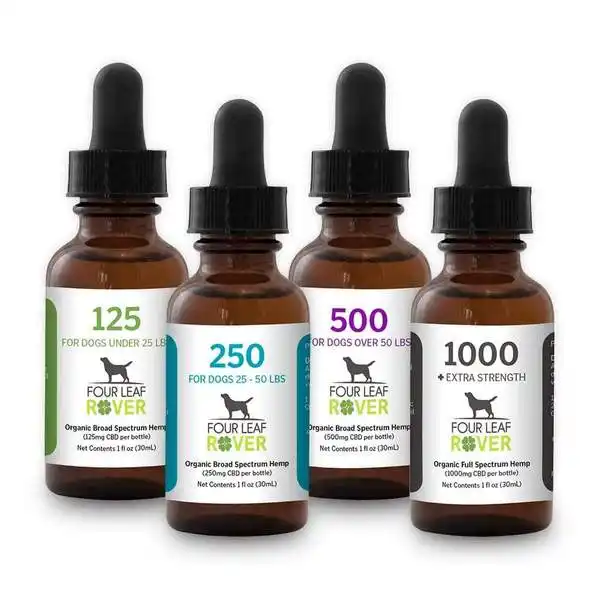
- Read the liquid’s stated milligrams of CBD, bottle volume and full ingredients. The numbers for total extract, all cannabinoids and CBD are different measures.
- Chews and treats
- Look for whether the stated amount refers to the whole bag, a serving or one chew. Do not use the bottle calculator for solids, or assume adult edibles are comparable.
- Isolate or “spectrum”
- Isolate refers to a single separated compound. “Broad-spectrum” and “full-spectrum” describe how an extract is marketed; look for the measured cannabinoids and reporting limits on the actual batch report. No label term verifies zero THC or a clinical benefit.
- Bottle lot F-018
Report lot F-017 - Mismatch. The report is for another batch. It tells you nothing reliable about the bottle in your hand.
- THC ND
Reporting limit not shown - Missing context. Not detected is not a guarantee of zero. Check what forms of THC the lab tested and at what limit.
- Trace metals not listed
Complete ingredients bottle label - Not an all-clear. Check which contaminants were tested and read the full ingredient list separately. A cannabinoid test does not test for xylitol or chocolate.
Calculate the concentration printed on a bottle
Read the total CBD for the whole bottle and its total volume. If the front only gives “hemp extract” or “total cannabinoids,” that does not tell you how much CBD it contains.
Fictional example: 300 mg CBD in a 30 mL bottle → 300 ÷ 30 = 10 mg CBD per mL. This describes the liquid, not how much to give a dog.
A matching report is useful documentation, not evidence that the oil works, is FDA-approved, or is safe to give.
Turn “something seems off” into a useful record
Track ordinary activity without staging a stressor or forcing movement. Choose the details that match what you are seeing.
A short record to copy or print
- Mobility: which normal task changed, since when, and how often?
- Stress: what happened just before the behavior, what did you see, and how long did recovery take?
- Seizures: date, time, approximate duration, and what recovery looked like; follow any emergency plan you already have.
- Context: list prescribed medicines, supplements, and recent changes. Note if nothing else changed.
One question worth asking: “What improvement would be meaningful, and what should make me stop and call?” Use your browser’s Print command for a checklist.

Common questions about CBD and dogs
Can a dog have too much CBD oil?
Yes, an unplanned extra amount can be a concern, especially if the ingredients or THC content are unclear. See what to do after accidental exposure; keep the package and don’t wait for signs.
Is there an FDA-approved CBD dosage for dogs?
No CBD product is FDA-approved for use in dogs. A published research dose is not a home dosing guide; product contents, health conditions and other medicines matter. Don’t convert a human dose or use an online chart.
Does CBD replace arthritis or seizure medication?
No. It is not a proven substitute for veterinary pain treatment, mobility care or prescribed antiseizure medicine. Ask the prescribing veterinarian before making any changes.